Which Fractional Laser Delivers Better Results: Matrix Fractional CO2 Laser or 1927nm Thulium Laser?
Introduction: The Evolving Landscape of Laser Aesthetics
The global medical aesthetics market continues its rapid expansion, driven by an aging population and increasing demand for minimally invasive procedures. According to a 2021 report by Grand View Research, the market size was valued at USD 15.9 billion in 2020 and is expected to grow at a CAGR of 10.8% through 2028. (Source:https://www.grandviewresearch.com/industry-analysis/medical-aesthetics-market)
Recent clinical evidence has further deepened our understanding of three mainstream technologies. These include: fractional CO2 lasers (10,600nm), 1927nm thulium lasers (classified as micro-ablative), and non-ablative fractional lasers (1,550nm). Each of these three technologies has a unique treatment mechanism and characteristics.
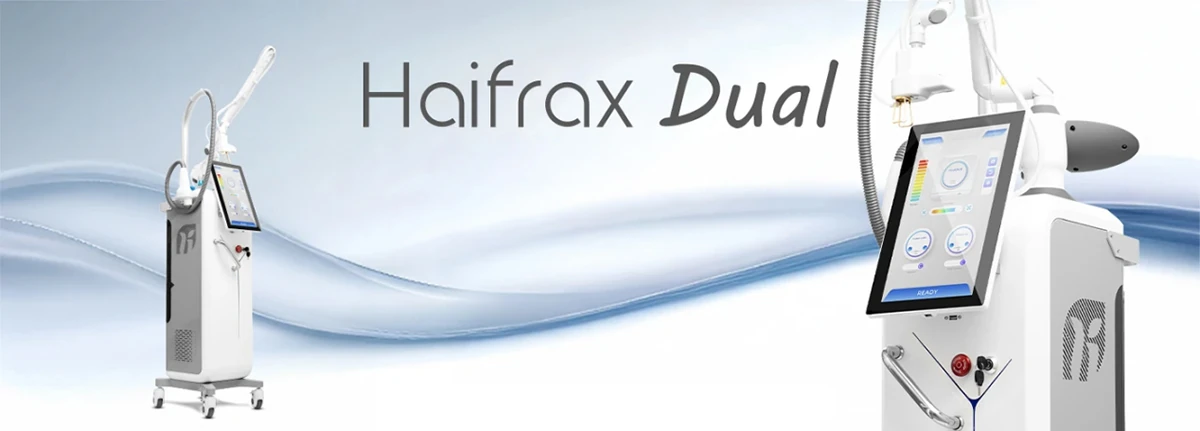
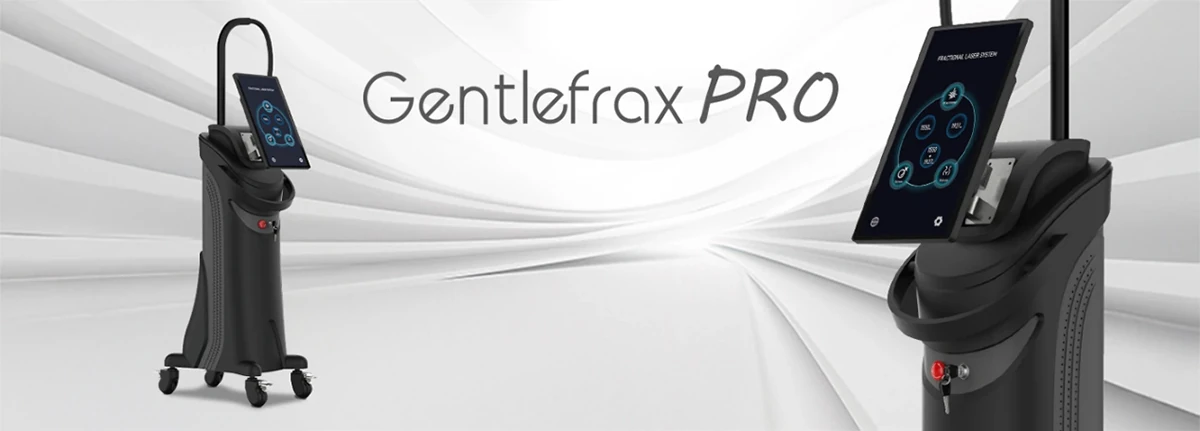
We will draw upon real-world case studies from Haidari Beauty—specifically featuring the Haifrax dual-wavelength (CO2 + Erbium-glass) laser system and the Gentlefrax PRO dual-wavelength (1550nm + 1927nm) fractional fiber laser system—to vividly demonstrate the actual performance of these technologies in clinical practice.
Understanding the Landscape: Ablative vs. Non-Ablative Fractional Lasers
Before diving into specific wavelengths, it is crucial to understand the fundamental difference in how these lasers interact with human tissue.
What is a Matrix Fractional CO2 Laser?
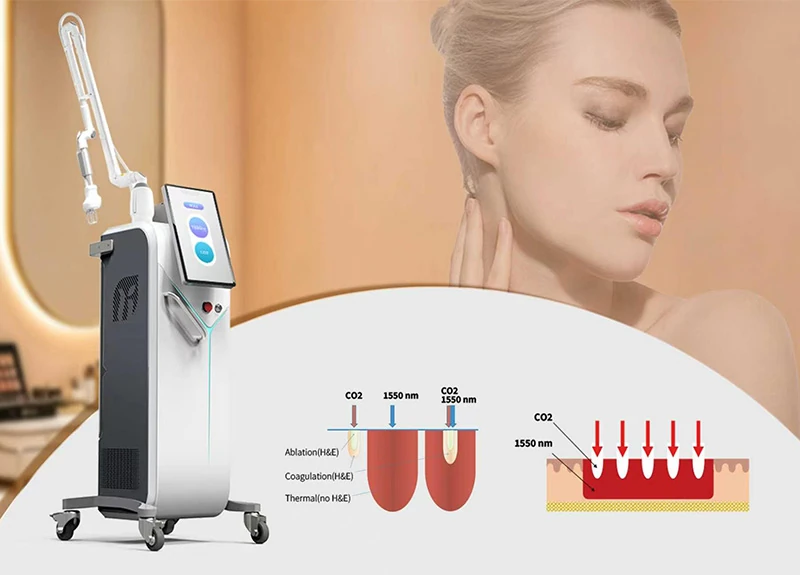
The matrix fractional CO2 laser operates at a wavelength of 10,600nm. This wavelength is highly absorbed by water, which makes up approximately 70-80% of the skin. When the laser light instantly vaporizes (ablates) microscopic columns of tissue on the skin, it creates tiny holes known as Microscopic Treatment Zones (MTZs).
What is a Non Ablative Fractional Laser?
In contrast, a non ablative fractional laser does not vaporize tissue. Instead, it uses wavelengths that penetrate deeper into the dermis while leaving the epidermis (the surface layer) intact. The most common wavelengths for these devices are 1550nm (Erbium Glass) and 1927nm (Thulium).
The Middle Ground: Micro-Ablative (1927nm)
The 1927nm thulium laser occupies a unique space. It is often classified as “micro-ablative.” While it does cause some superficial vaporization of the epidermis (specifically targeting water and melanin), this vaporization occurs with such precision and at such a shallow depth that the skin barrier remains largely functional. It is the perfect bridge between the aggressive CO2 and the gentle 1550nm.
The Gold Standard: Deep Dive into the Matrix Fractional CO2 Laser
Mechanism of Action
The 10,600nm wavelength is absorbed by intracellular water. When the laser pulse is delivered, it heats the water to the point of vaporization. This creates a channel through the epidermis and into the dermis. The thermal energy surrounding this channel causes immediate collagen contraction (tightening) and initiates a healing cascade that lasts for months.
Limitations
The primary drawback of the matrix fractional CO2 laser is downtime. Patients typically experience 5-10 days of redness, swelling, and oozing. There is also a higher risk of PIH, especially in darker skin types (Fitzpatrick IV-VI), due to the significant inflammatory response.
The Precision Tool: The Power of 1927nm Thulium Laser and Non Ablative Fractional Laser
Why 1927nm is Unique
The 1927nm wavelength is uniquely absorbed by both water and melanin. This makes it a “pigment magnet.” It targets the superficial layers of the skin where sun damage and pigmentation reside. Unlike CO2, which removes tissue, the 1927nm thulium laser gently exfoliates the stratum corneum and disrupts melanosomes (pigment cells) with minimal thermal damage to the surrounding dermis.
Why 1550nm is the King of Collagen
The 1550nm wavelength penetrates deeper than 1927nm but does not ablate the surface. It is the ideal non ablative fractional laser for building collagen over time. It is safe for all skin types and can be used year-round, even in sunny climates, as it does not break the skin barrier.
Head-to-Head Comparison Chart
| Parameter | Haifrax Dual (Matrix Fractional CO2 Laser) | Gentlefrax PRO (1927nm Thulium Laser + Non Ablative Fractional Laser) |
| Primary Wavelength | 10,600nm (CO2) + 1,550nm (Er:Glass) | 1,927nm (Thulium) + 1,550nm (Er:Glass) |
| Ablation Classification | Ablative (CO2) + Non-ablative (1550nm) | Micro-ablative (1927nm) + Non-ablative (1550nm) |
| Max Effective Depth | ~1.5 mm (synchronized) | ~1.5 mm (1550nm dermal) + epidermal (1927nm) |
| Typical Downtime | 7–10 days | 1–3 days |
| Patient Comfort | Moderate–High (anesthesia required) | Mild–Moderate (often anesthesia-free) |
| Best Clinical Indications | Deep scars, full-thickness revision, skin laxity | Pigmentation, texture, mild-moderate scars, melasma |
| Fitzpatrick Range | I–IV (with protocol adjustments) | I–VI (significantly reduced PIH risk) |
| Typical Sessions | 1–3 for major indications | 3–5 for optimal remodeling |
| Laser Source | U.S. Coherent CO2 RF tube (>10⁹ shots) | China’s leading 20W Thulium + 30W Er:Glass |
| Scan/Handpiece | Up to 20×20 mm scan area | 5 / 10 / 20 mm interchangeable handpieces |
| Customization | Full ODM/OEM (software, parameters, branding) | Full ODM/OEM support |
| Warranty | 2 years | 2 years |
| Revenue Model | High-ticket, low-frequency | High-frequency, broad patient base |
Commercial Strategy: Which Platform Fits Your Clinic Model?
Scenario A: Startup Clinic / Medical Spa
Recommendation: GentleFrax PRO is the top choice.
This approach, which combines a 1927nm thulium laser with a non-ablative fractional laser, can serve the broadest range of patients. Patients with Fitzpatrick skin types III to VI—who make up the majority of the global aesthetic medicine market—are all eligible for safe treatment with a very low risk of post-treatment hyperpigmentation (PIH). A recovery period of just 1 to 3 days means patients can return to work quickly. Its three modes (standard mode, sliding mode, and private mode) and three treatment handpieces can maximize the return on investment (ROI) of a single device. A very high repeat visit rate helps build a sustainable revenue stream, while also significantly reducing customer acquisition barriers and costs.
Scenario B: Dermatology / Surgical Centers
Recommendation: Haifrax Dual is indispensable.
When your referral pool includes deep acne scars, burn contractures, surgical repairs, and severe skin laxity, fractional CO2 lasers are the only cutting-edge technology capable of deep structural improvements. It serves as a core pillar for professional medical institutions seeking clinical credibility. When used in conjunction with Gentlefrax PRO, which provides post-operative care and skin rejuvenation, a complete and well-defined service system can be built.
Scenario C: High-end Flagship Clinics
Recommendation: Dual-Device Integration—Implement and Strategic Deployment.
Use Haifrax to treat localized, severe conditions (such as deep scars and sagging skin); use Gentlefrax PRO for full-face refinement (to improve skin texture, skin tone, enlarged pores, and pigmentation). This dual-platform collaborative strategy can be described as “from the inside out plus from the outside in.” It not only helps your clinic stand out from competitors that rely on a single device, but also enables differentiated pricing across all service levels.
As Haidari’s clinical documentation states: “Over 15 years of clinical evidence supports both wavelengths independently; Haidari Duo offers true synchronized delivery without sacrificing individual mode performance.”
FAQ
Q1: What is the fundamental difference between a matrix fractional CO2 laser and a non ablative fractional laser?
A: The matrix fractional CO2 laser (10,600nm) vaporizes tissue in micro-columns, creating an ablative wound that triggers strong collagen remodeling. It delivers the most dramatic single-session results but requires 7–10 days of recovery. The non ablative fractional laser (1550nm) heats dermal tissue without breaking the skin surface, offering progressive improvement with only 1–3 days of downtime. For clinic operators, this translates to: CO2 = high-ticket, low-frequency; non ablative fractional laser = high-frequency, broad-base revenue.
Q2: Is the 1927nm thulium laser ablative or non-ablative?
A: The thulium laser is micro-ablative. It removes the epidermis in controlled micro-zones—more precise than a fully ablative matrix fractional CO2 laser but more aggressive than a pure non ablative fractional laser. This makes it ideal for pigmentation, superficial texture, and actinic damage while preserving the safety profile that clinics need for Fitzpatrick III–VI patients.
Q3: Can a matrix fractional CO2 laser be used safely on darker skin tones?
A: The fractional CO2 laser carries elevated PIH (post-inflammatory hyperpigmentation) risk on Fitzpatrick V–VI skin and requires strict protocol control. The Gentlefrax PRO’s non ablative fractional laser (1550nm) and 1927nm thulium laser are specifically engineered for diverse skin types, with integrated cooling and adjustable parameters that minimize PIH risk. For clinics serving multi-ethnic patient populations, the Gentlefrax PRO is the safer default platform.
Q4: How do synchronized dual-wavelength systems compare to running two separate devices?
A: Synchronized emission is clinically superior to sequential treatment from two separate machines. When the matrix fractional CO2 laser creates micro-channels, it reduces epidermal impedance in real time, allowing the non ablative fractional laser (1550nm) or thulium laser (1927nm) energy to penetrate deeper within the same pass. This synergy reduces total treatment time, improves energy efficiency, and delivers outcomes that sequential protocols cannot match.
Conclusion
The fractional CO2 lasers remain one of the most effective methods for achieving deep structural remodeling. Meanwhile, the 1927nm Thulium laser has emerged as one of the most advanced modalities for treating pigmentation issues and refining epidermal texture. Haifrax Dual and Gentlefrax PRO are not competing products; rather, they are complementary platforms that collectively cover the entire spectrum of clinical treatments. Haifrax specializes in deep structural reconstruction, while Gentlefrax PRO excels at refining the epidermis. By combining the strengths of both systems, clinics are empowered to serve a diverse patient base—effortlessly addressing everything from deep acne scars to melasma, and handling treatments ranging from full-depth skin repair to immediate skin rejuvenation.