
Q-Switched Nd:YAG Laser Buyer’s Guide: Applications, Specifications & How to Choose
Key Takeaways
A Q-switched nd yag laser uses short, high-energy pulses to target unwanted pigments and is widely used for tattoo removal and certain pigmentation treatments.
Dual 1064 nm and 532 nm wavelengths provide flexibility for different pigment colors and depths.
Haidari’s RE-BEAN system combines a 4–6 ns pulse width, up to 1400 mJ energy, 10 Hz frequency, and 3% energy stability tolerance.
For B2B buyers, laser components, regulatory documentation, treatment flexibility, service support, and total operating value should be evaluated together.
What Is a Q-Switched Nd:YAG Laser Used For?
A Q-Switched Nd:YAG laser is a pulsed laser system that delivers high energy within a very short pulse duration. This creates a photoacoustic effect that can fragment targeted pigment particles while limiting unnecessary heat accumulation in surrounding tissue. In professional aesthetics, the technology is commonly associated with tattoo removal and selected pigmentation treatments.
A q switch nd yag laser tattoo removal machine can use different wavelengths to address pigments at different depths and with different absorption characteristics. The 1064 nm wavelength is generally associated with darker and deeper pigment targets, while 532 nm is commonly selected for certain red, orange, and lighter pigment applications. The American Academy of Dermatology notes that different tattoo colors can respond differently to laser wavelengths and that multiple treatment sessions are often required.
How Does Q-Switching Work?
The basic process can be summarized as:
Energy storage → Q-switching → a short high-energy pulse → pigment absorption → photoacoustic fragmentation → gradual pigment clearance
The short pulse is important because it allows a high amount of energy to be delivered over a limited period. According to the American Society for Dermatologic Surgery, Q-switched lasers are among the technologies used for tattoo removal, with treatment parameters selected according to factors such as tattoo characteristics and pigment color.
Why Are 1064 nm and 532 nm Important?
The 1064 nm Q-switched laser wavelength is generally suitable for darker pigments and deeper targets, while 532 nm can provide additional flexibility for certain lighter or red-toned pigments. With the dual-wavelength system, clinics can handle various pigmentation issues more effectively without being limited by the capabilities of a single wavelength.
Dual-wavelength platforms are certainly more flexible than single-wavelength options. But don’t assume two wavelengths automatically mean better performance. Energy range, pulse characteristics, beam size, and the intended application all deserve careful consideration.
Which Technical Specifications Matter When Choosing a Q-Switched Nd:YAG Laser?
For professional buyers, evaluating a Q-Switched Nd:YAG laser requires more than looking at maximum power. Pulse width, energy output, repetition rate, beam quality, spot size, optical delivery, and cooling all influence how effectively a system can adapt to different treatment requirements.
Pulse Width, Energy and Spot Size
Pulse width determines how quickly laser energy is delivered, while energy and fluence indicate the amount of energy available for treatment. Spot size affects the coverage and energy distribution of each pulse.
| Technical Parameter | Why It Matters |
| Pulse width | Influences the duration of energy delivery |
| Energy output | Determines available treatment intensity |
| Frequency | Affects treatment speed and workflow |
| Spot size | Determines treatment coverage and flexibility |
| Wavelength | Influences the target pigments and applications |
A shorter pulse width can provide a high peak power within a limited period, but it should not be considered independently from energy stability, beam quality, and spot-size options.
Beam Quality and Energy Stability
Beam profile is another important consideration that is often overlooked in equipment procurement. A Top-Hat beam profile is designed to distribute energy more evenly across the treatment spot, while a Gaussian profile has a higher energy concentration toward the center.
Buyers should therefore ask manufacturers whether beam-profile information and energy-stability test data are available. Consistent output can be particularly important for clinics operating the equipment frequently or for distributors comparing systems intended for professional use.
Optical Delivery and Cooling
Optical delivery affects handling, positioning, maintenance, and long-term usability. Articulated arms can provide controlled movement across the treatment area, while fiber-based delivery systems may offer different flexibility and maintenance characteristics.
Cooling is key to stable operation. When selecting equipment, evaluate the cooling method, temperature monitoring, flow protection, duty cycle, and maintenance. For busy clinics, continuous operation capability should be a deciding factor upfront—don’t wait until after installation to find out it falls short.
How to Evaluate a Q-Switched Nd:YAG Laser Manufacturer?
Components, Certifications and Factory Capability
The laser cavity, laser rod, optical switch, KTP, lamp, and optical arm all contribute to the overall system configuration. Buyers should request information on component origin, expected service life, replacement procedures, and maintenance requirements.
In the United States, buyers should separately verify whether FDA 510(k) clearance or another regulatory pathway applies to the intended product and use. The FDA provides public records for cleared medical devices, making model-specific verification possible.
OEM/ODM and After-Sales Support
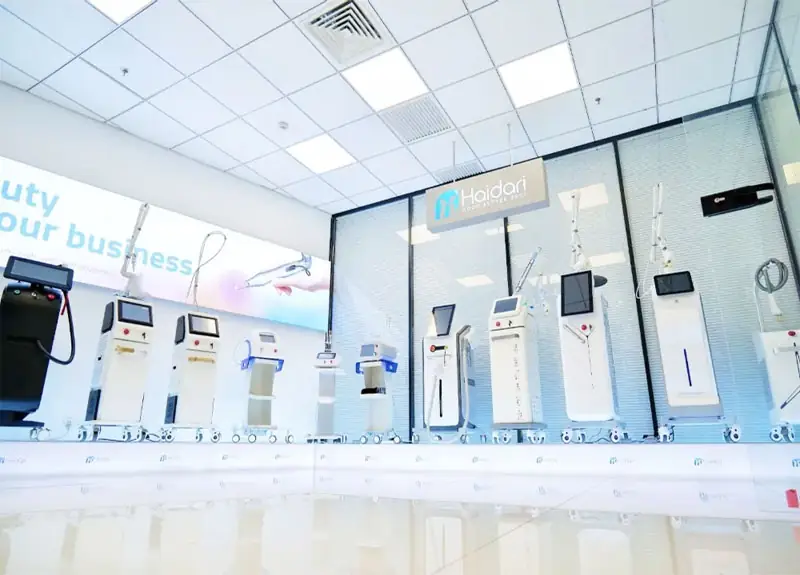
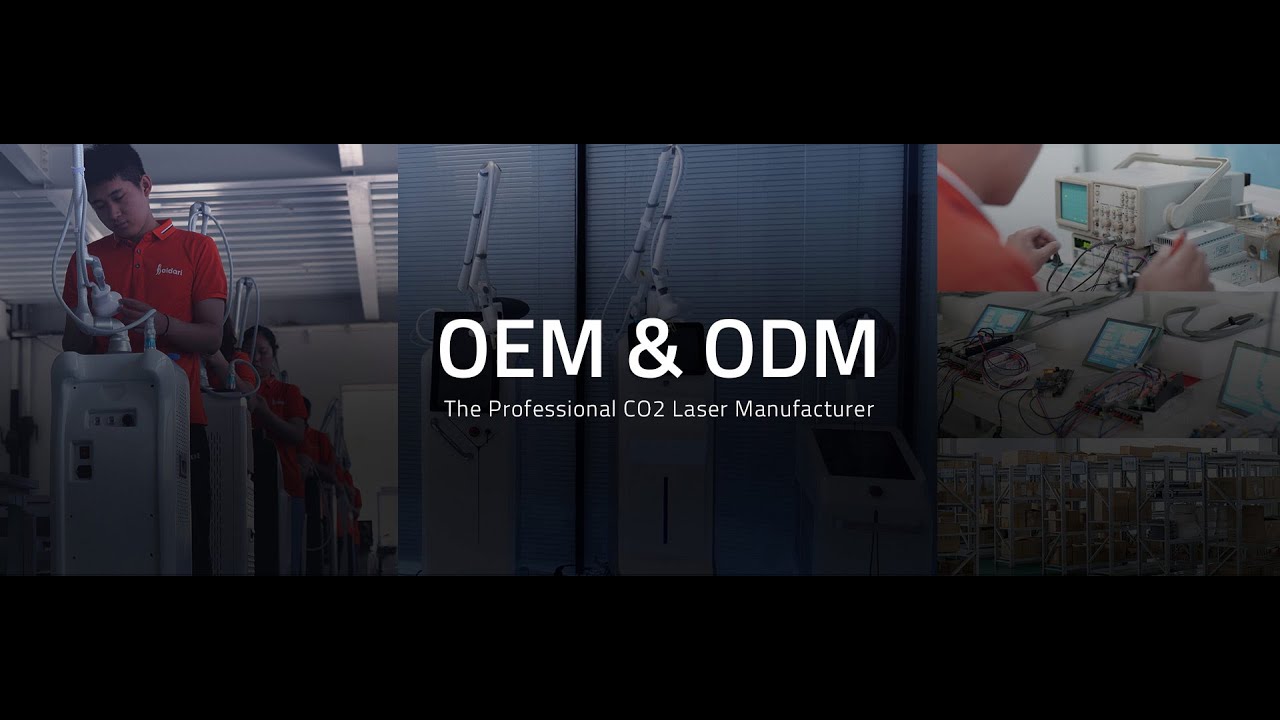
For distributors and private-label buyers, relevant customization may include logo application, software localization, housing design, packaging, and electrical configurations. Before ordering, buyers should confirm MOQ, lead time, warranty coverage, spare-parts availability, technical training, and remote support.
International shipping should also be considered. Precision optical components require appropriate packaging and transport protection, particularly when equipment is shipped over long distances.
RE-BEAN Q-Switched Nd:YAG Laser: Product Example
The RE-BEAN Q-Switched Nd:YAG Laser combines dual-wavelength operation with multiple pulse and energy configurations for professional aesthetic applications. Its core configuration includes 1064 nm and 532 nm wavelengths, a 4–6 ns pulse width, up to 1400 mJ energy, 10 Hz frequency, and 3% energy stability tolerance.
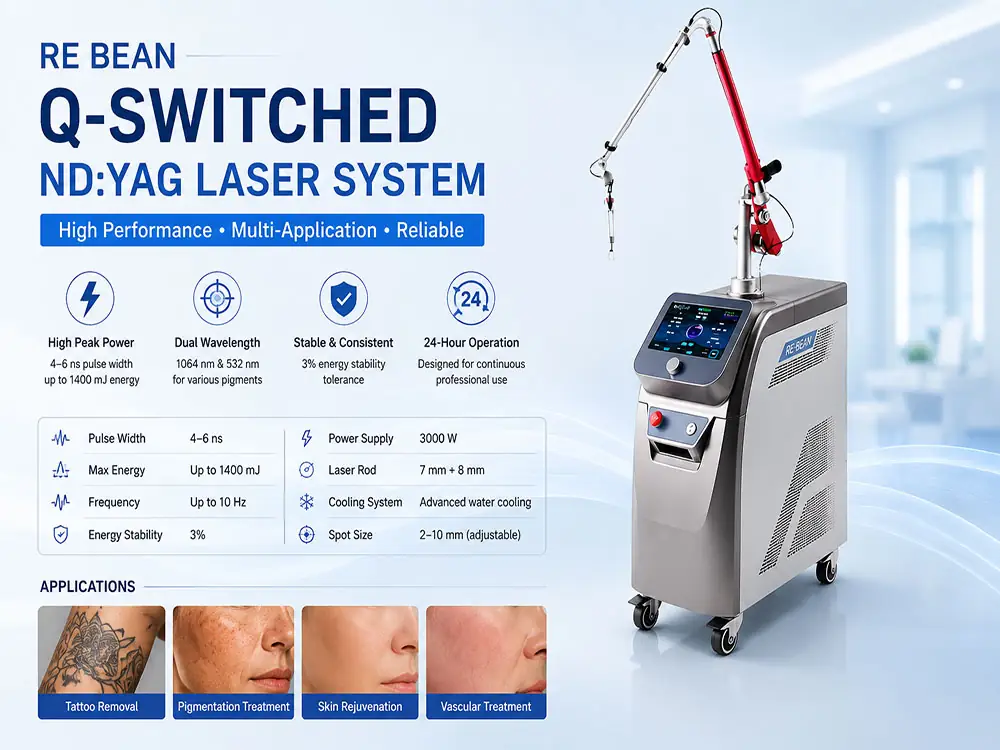
Key Product Specifications
| Item | RE-BEAN Specification |
| Wavelength | 1064 nm / 532 nm |
| Pulse width | 4–6 ns |
| Maximum energy | 1400 mJ |
| Frequency | Up to 10 Hz |
| Energy stability | 3% tolerance |
| Power supply | 3000 W |
| Laser rod | 7 mm + 8 mm |
| Laser arm | Korean laser arm |
| KTP | Japan imported |
| Lamp | UK imported |
| Optical switch | America imported |
The system is positioned for beauty salons, beauty clinics, and dermatology clinics. Its dual-wavelength configuration can support tattoo removal and pigment-related applications, while its parameter flexibility can also support broader skin-improvement projects depending on the treatment protocol and local regulatory requirements.
For clinics seeking to expand beyond a single treatment category, this configuration provides a practical way to build a broader laser-service portfolio. For distributors, the combination of technical specifications, imported core components, and potential OEM/ODM support can also provide flexibility when developing market-specific equipment offerings.
From a Single-Function Device to a Multi-Project Platform
A European middle- to high-end beauty clinic provides a useful application example. Its existing equipment was primarily used for basic skin-rejuvenation services, while growing demand for pigmentation management, tattoo fading, and overall skin improvement exposed limitations in project coverage and treatment flexibility.
After introducing Haidari’s dual-wavelength Q-Switched Nd:YAG system, the clinic was able to add pigment management, tattoo fading, and broader skin-improvement services. According to the supplied case information, clinicians found the operating logic clear and parameter adjustment flexible, while the wider project portfolio helped improve equipment utilization and supported a more complete laser-service matrix.
A Practical ROI Framework
The supplied business model estimates that, where a single treatment session can exceed $300, equipment investment may potentially be recovered within around two months under suitable utilization conditions, with a projected lifetime ROI exceeding 1:100. These figures should should be viewed as manufacturer estimates, not performance guarantees, because actual ROI depends on local treatment prices, patient volume, utilization, operating costs, and regulatory conditions.
A more conservative buyer calculation is:
Payback period = Total equipment investment ÷ Monthly incremental gross profit
This approach allows clinics and distributors to replace assumed treatment prices and utilization rates with their own market data.
FAQ
Q1. What is the difference between 1064 nm and 532 nm in a Q-Switched Nd:YAG laser?
A: 1064 nm is generally used for darker and deeper pigment targets, while 532 nm is commonly selected for certain lighter or red-toned pigments. The appropriate wavelength depends on the pigment, treatment objective, device configuration, and applicable indications.
Q2. Is a 4–6 ns pulse width important for tattoo removal?
A: A shorter pulse can deliver high energy over a brief period and is an important parameter when evaluating Q-Switched Nd:YAG systems. However, pulse width should be assessed together with energy, spot size, beam quality, and energy stability rather than used as the sole performance indicator.
Q3. Can a Q-Switched Nd:YAG laser be used for more than tattoo removal?
A: Yes. Depending on the configuration and applicable indications, Q-Switched Nd:YAG systems can support pigmentation-related treatments and selected cosmetic applications. The RE-BEAN system is positioned for beauty salons, beauty clinics, and dermatology clinics and is designed around multiple treatment applications.
Q4. How should buyers verify the manufacturer’s certifications?
A: Buyers should request certificates and test reports for the exact model and verify that they correspond to the intended market. The FDA maintains public databases for U.S. medical-device clearances, while CE and ISO documentation should be checked against the applicable regulatory framework and product configuration.
Conclusion
A Q-switched Nd:YAG laser is only as good as its total performance—not a single spec. Hardware, service, stability, and running costs all matter.
For clinics and distributors comparing a q switch nd yag laser tattoo removal machine, RE-BEAN offers a configuration built around dual wavelengths, 4–6 ns pulse width, up to 1400 mJ energy, 10 Hz frequency, and 3% energy stability tolerance. Its combination of pigment-focused applications and broader treatment flexibility can make it relevant to businesses looking to expand their laser-service portfolio.
Looking for a Q-Switched Nd:YAG laser for your clinic, distribution business, or OEM/ODM project? Contact Haidari Beauty to discuss the RE-BEAN configuration, technical specifications, and sourcing requirements for your target market.