
How Dual-Wavelength Fractional Lasers Address Both Skin Texture and Pigmentation
Key Takeaways
A 1550nm laser is generally used for deeper dermal thermal remodeling, while a 1927nm thulium laser has stronger water absorption and is more suitable for superficial resurfacing and pigmentation-related concerns.
Combining the two wavelengths can give aesthetic clinics a broader treatment platform for texture, wrinkles, scars, photoaging, and pigmentation.
A non ablative fractional laser creates microscopic treatment zones rather than treating the entire skin surface uniformly, which can support a shorter recovery profile than fully ablative resurfacing.
For B2B buyers, wavelength should be evaluated together with pulse energy, pulse duration, scanning technology, handpiece design, regulatory documentation, service support, and total operating cost.
1550nm vs. 1927nm: How Do They Work?
1550nm Laser for Dermal Remodeling
A 1550nm fractional erbium glass laser is commonly associated with non-ablative fractional treatment. Its energy is designed to generate controlled microscopic thermal zones within the dermis while preserving surrounding tissue.
This mechanism can support collagen remodeling and is relevant to concerns such as atrophic acne scars, fine lines, enlarged pores, uneven texture, and skin laxity. The clinical response depends on parameters including fluence, pulse duration, treatment density, passes, skin type, and treatment interval.
1927nm Thulium Laser for Pigmentation and Surface Resurfacing
A 1927nm thulium laser has stronger absorption by water than longer-wavelength systems commonly used for deeper dermal remodeling. It is therefore particularly relevant to superficial photodamage and pigmentation.
Clinical evidence supports this application. In a prospective multicenter study of 40 patients with facial photopigmentation, two treatments with a non-ablative 1927nm fractional thulium laser produced moderate to very significant overall improvement in 82% of subjects at one month and 69% at three months. Approximately 68% and 51% showed moderate to very significant improvement in lentigines and ephelides at those respective follow-ups.
Importantly, the study included Fitzpatrick skin types I–IV and specifically noted the lack of data for types V–VI. Therefore, darker skin should not be described as automatically risk-free; treatment parameters and clinical assessment remain essential.
Why Combine 1550nm and 1927nm Fractional Laser Technologies?
Skin rejuvenation is rarely a single-depth problem. Acne scars, wrinkles, enlarged pores, and loss of elasticity are associated largely with dermal remodeling, while superficial pigmentation, photodamage, and uneven tone are closer to the epidermal and epidermal-dermal junction.
This is why a 1550nm laser and a 1927nm system can have complementary roles. DermNet NZ describes fractional laser treatment as a technique that delivers thousands of microscopic treatment zones to only a fraction of the skin at a time. Fractional treatment divides laser energy into microscopic treatment zones, leaving untreated tissue between the zones.
Different Wavelengths, Different Treatment Depths
The basic principle is straightforward: wavelength influences how laser energy interacts with tissue water and therefore where thermal energy is deposited.
| Wavelength | Primary Tissue Focus | Typical Application Direction |
| 1550nm | Deeper dermal tissue | Acne scars, wrinkles, texture, collagen remodeling |
| 1927nm | More superficial water-rich tissue | Dyschromia, photodamage, superficial texture |
| 1550nm + 1927nm | Multiple tissue levels | Comprehensive skin rejuvenation |
The goal of dual-wavelength treatment is therefore to address different layers and clinical concerns within one treatment platform.
What Should B2B Buyers Evaluate Before Purchasing?
Check Laser Output and Pulse Control
A practical procurement evaluation should include laser source type, output power, pulse energy, pulse duration, spot size, beam delivery, and scanning stability.
For example, a system with a wide adjustable energy range can give clinicians more flexibility when developing protocols for different treatment areas and skin conditions. Buyers should request laboratory specifications.
Evaluate the Scanning System
Fractional performance also depends on how energy is distributed across the treatment area. Galvanometer scanning, adjustable density, spot dimensions, and different scanning modes can influence treatment uniformity and procedure efficiency.
A useful evaluation process is:
- Confirm the available treatment modes and scanning patterns.
- Compare energy and pulse-duration adjustment ranges.
- Check handpiece and spot-size options.
- Review cooling, safety controls, maintenance requirements, and service documentation.
Consider Safety and Regulatory Requirements
Laser treatment can involve risks including pain, infection, scarring, and skin color changes, according to the U.S. Food and Drug Administration. Medical laser products marketed in the United States are also subject to applicable radiation-safety and medical-device requirements.
For distributors and importers, documentation such as IEC 60601-1, ISO 13485, applicable market registration, labeling, and technical files should therefore be evaluated before purchase. Certification claims should always be checked against the exact device and destination market.
Product Example: Gentlefrax PRO 1550nm + 1927nm Dual Fractional Fiber Laser
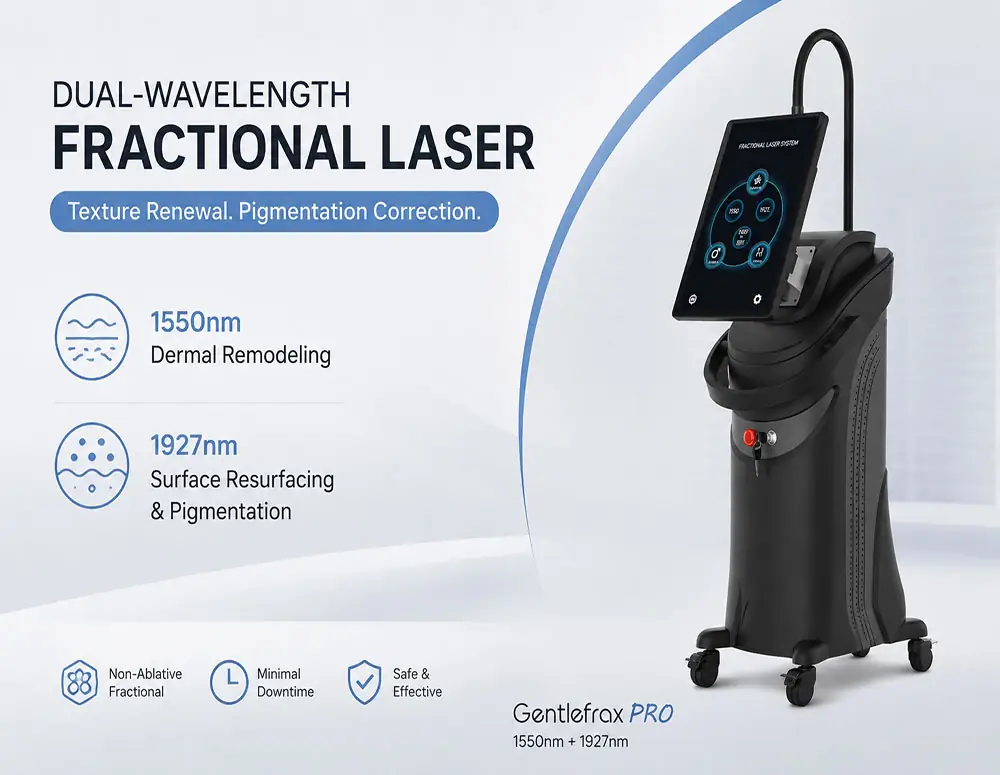
After evaluating the technology from a procurement perspective, a practical example is the Gentlefrax PRO from Haidari Beauty. The system combines 1550nm and 1927nm fractional laser technologies for applications involving dermal remodeling, superficial pigmentation, and skin resurfacing.
Core Specifications
| Specification | Gentlefrax PRO |
| 1550nm source | 30W Erbium Glass |
| 1927nm source | 20W Thulium |
| Beam configuration | Combined 1550nm + 1927nm |
| Pulse energy | 0–300 mJ |
| Pulse duration | 0.1–10 ms |
| Scanner | 15 × 22 mm galvanometer scanner |
| Scanning motor | 240W |
| Certifications / quality system | IEC 60601-1, ISO 13485 |
The platform is designed for continuous operation, which may be relevant to clinics with relatively high daily utilization.
Main Applications
The 1550nm side is positioned for dermal remodeling applications such as atrophic acne scars, fine lines and wrinkles, surgical or traumatic scars, enlarged pores, skin laxity, and stretch marks.
The 1927nm side is intended for concerns including photoaging, dyschromia, superficial pigmentation, uneven texture, and selected pigment-related applications. The synchronized mode is designed to combine the two wavelengths for broader skin-rejuvenation protocols.
It has Standard Fractional, Sliding Mode, and Private Mode, together with interchangeable 5mm, 10mm, and 20mm handpieces.
Clinical Case: 94 Patients Over Six Months
A premier aesthetic clinic in Singapore previously relied on separate 1550nm and 1927nm systems for dermal and superficial concerns. After adopting the dual-wavelength platform, the clinic treated 94 patients over six months.
One reported case involved a 52-year-old female with pronounced perioral wrinkles and diffuse lentigines. After three monthly sessions, the supplier reported a 48% reduction in wrinkle depth and a 62% improvement in pigmentation homogeneity. Overall patient satisfaction reportedly increased from 71% to 96%, while treatment time was reduced by 35% and reported postoperative erythema duration decreased from five days to two days.
From a commercial perspective, the same case materials report that individual treatments may exceed $300 and estimate that equipment payback can occur within approximately two months under certain utilization assumptions, with a potential lifetime ROI above 1:100. Actual ROI will depend on equipment cost, treatment pricing, patient volume, utilization, consumables, staffing, and local market conditions.
FAQ
Q1: What is the primary clinical distinction between a 1550nm Erbium Glass laser and a 1927nm Thulium laser?
A: A 1550nm Erbium Glass system generally targets deeper dermal tissue for collagen remodeling and texture-related concerns, while 1927nm Thulium treatment has stronger water absorption and is more focused on superficial resurfacing, photodamage, and pigmentation-related concerns.
Q2: How does a non-ablative fractional laser reduce downtime compared with fully ablative CO2 treatment?
A: A non ablative fractional laser creates microscopic thermal treatment zones while leaving surrounding tissue intact. This fractional approach can support faster recovery than broad ablative resurfacing, although downtime varies with wavelength, energy, density, skin type, and treatment protocol. DermNet NZ describes fractional treatment as targeting only a fraction of the skin at a time.
Q3: Can 1927nm Thulium lasers be used for darker skin phototypes?
A: They may be used in appropriately selected patients, but “zero PIH risk” should not be promised. Published evidence varies by skin type and protocol. For example, a prospective 1927nm study included Fitzpatrick I–IV but did not include types V–VI.
Q4: What should distributors check before importing a dual-wavelength fractional laser?
A: Distributors should verify the exact laser sources, energy and pulse ranges, scanning modes, cooling and safety systems, consumable structure, warranty, spare-parts support, ISO 13485 documentation, IEC testing, and the regulatory requirements of the target market. In the United States, medical laser products are subject to FDA medical-device and radiation-safety requirements.
Conclusion
For B2B aesthetic equipment buyers, the value of dual-wavelength fractional technology lies in its ability to address different treatment depths within one platform. The 1550nm laser provides a route toward deeper dermal remodeling, while the 1927nm thulium laser is particularly relevant to superficial pigmentation and photodamage.
The Gentlefrax PRO combines these wavelengths with adjustable energy and pulse-duration control, galvanometer scanning, and a dual-wavelength configuration. For clinics, distributors, and OEM/ODM buyers, the most useful evaluation is whether the complete system provides the right combination of clinical versatility, technical control, documentation, serviceability, and long-term commercial value.
Looking for a reliable dual-wavelength fractional laser for your clinic or distribution business? Contact us to discuss Gentlefrax PRO configurations, OEM/ODM options, certifications, and a tailored quotation for your target market.