
How to Choose a Diode Laser Hair Removal Machine: Key Specifications and Buying Guide
Key Takeaways
Choosing a diode laser hair removal machine requires more than checking the highest power number or the lowest purchase price. For clinics, MedSpas, and B2B buyers, several specifications work together to determine treatment efficiency, operating stability, and long-terlm equipment value.
The main factors to review include:
- Wavelength and its suitability for different skin and hair characteristics
- Laser power, pulse frequency, and actual energy output
- Spot size and its effect on treatment speed
- Cooling performance during repeated treatments
- Handpiece lifetime and replacement requirements
- Regulatory documents, technical data, and after-sales support
A useful comparison should therefore look at how the specifications work together rather than treating one number as the main measure of machine quality.
What Is a Diode Laser Hair Removal Machine?
A diode laser hair removal machine uses laser energy to heat the hair follicle and reduce its ability to produce new hair. The laser energy is absorbed mainly by melanin, the pigment found in hair and skin. The treatment aims to deliver enough controlled heat to the hair follicle while limiting unwanted heating of the surrounding skin.
Diode systems commonly use wavelengths around 800–810 nm, while some professional systems, including an 808nm diode laser hair removal machine, use 808 nm as the main treatment wavelength. Other systems offer additional wavelengths such as 755 nm and 1064 nm. Different wavelengths interact with melanin and tissue at different depths, so wavelength selection can affect how a treatment is planned for different patients.
How Diode Laser Hair Removal Works
The basic process is based on selective photothermolysis. This term describes the use of light energy to create a controlled thermal effect in a selected target while limiting unnecessary effects on surrounding tissue.
During hair removal, the laser energy is absorbed by pigment in the hair. The resulting heat reaches the follicular structures and can damage the cells responsible for hair growth. Because skin also contains melanin, treatment parameters must be selected carefully, especially for darker skin tones.
Cooling is also important because it helps manage heat at the skin surface during treatment. Modern systems may combine contact cooling, water cooling, or other thermal-management methods.
Common Diode Laser Configurations
Diode laser hair removal machines can differ significantly in configuration. Some use a single wavelength, while others provide two or more wavelength options. A triple wavelength diode laser hair removal system may combine 755 nm, 808 nm, and 1064 nm wavelengths to provide a broader range of wavelength options.
Machines can also vary in handpiece power, pulse frequency, spot size, cooling design, and user controls. A professional diode laser hair removal machine may offer a broader combination of these specifications to support different treatment areas and clinic workflows.
Key Specifications to Review Before Buying
Wavelength
Wavelength is one of the first specifications to check because it affects how laser energy interacts with melanin and how deeply the energy can penetrate.
A wavelength around 800–810 nm is widely used for diode laser hair removal. A 755 nm wavelength has higher melanin absorption and is commonly associated with lighter skin and pigmented hair, while 1064 nm penetrates more deeply and has lower melanin absorption, which can make it useful when treating darker skin types under appropriate clinical protocols.
A multi-wavelength machine can offer more flexibility, but buyers should not assume that more wavelengths automatically mean better treatment. The important question is whether the available wavelengths match the clinic’s patient population and treatment needs.
Laser Power and Pulse Frequency
Power and pulse frequency describe different parts of machine operation.
Power indicates the rate at which electrical energy is converted into laser output within a specified system or component. A higher number does not automatically mean better clinical performance.
Pulse frequency indicates how many pulses can be delivered per second. Higher frequency can support faster treatment, particularly when treating large areas, but it should be considered together with energy delivered per pulse, pulse duration, cooling, and the machine’s ability to maintain stable output.
Energy Output and Output Stability
Energy output is more useful than a headline power figure when the goal is to understand what the device actually delivers during treatment.
Fluence refers to the amount of laser energy delivered over a specific area. It is an important treatment parameter because the same total power can produce different energy densities depending on spot size and pulse settings.
Output stability also matters during repeated treatments. A machine may perform well for a short period but show changes in output as internal components heat up.
Spot Size
Spot size refers to the area covered by each laser pulse. It directly affects how much skin can be treated with each pulse.
A smaller spot can make it easier to work around small or curved areas. A larger spot can cover more skin with each pulse and can be useful for areas such as the legs, back, or abdomen.
Cooling System
Cooling helps control heat at the treatment tip and the skin surface. It can improve patient comfort and help manage thermal stress during repeated treatments.
For a busy clinic, cooling performance becomes particularly important because a machine may be used continuously for multiple appointments. Buyers should look at the cooling method, cooling response, and how the system is designed to maintain operating conditions during extended use.
Handpiece Lifetime
The handpiece is one of the components that can have a major effect on long-term operating costs. Diode systems may specify a rated number of shots, but the figure should be viewed alongside the operating conditions, warranty terms, and replacement process.
A long rated lifetime can reduce the need for frequent handpiece replacement and may help lower long-term operating costs.
How These Specifications Affect Treatment Efficiency
Technical specifications become more useful when they are connected to actual clinic workflow. Treatment speed, consistency, and comfort usually depend on several specifications working together.
Spot Size and Treatment Speed
Spot size has a direct effect on treatment coverage. A larger spot covers more skin with each pulse, which can reduce the number of pulses required for large areas.
For example, a clinic treating legs or backs may benefit from a larger treatment tip, while smaller facial areas may require a more precise spot size.
A machine with interchangeable spot sizes gives operators more flexibility within the same treatment session. The useful question is therefore not simply “How large is the spot?” but “Does the available spot-size range fit the areas the clinic treats most often?”
Cooling and Continuous Operation
Cooling becomes increasingly important as treatment volume rises. During repeated sessions, the laser source, optical components, and handpiece can generate and absorb heat.
A cooling system helps manage this heat and maintain suitable treatment conditions. Contact cooling works at the treatment tip and can help control heat at the skin surface during pulse delivery, while internal cooling helps manage heat within the machine.
What to Check Before Buying a Diode Laser Hair Removal Machine
Compare Technical Specifications
A simple comparison table can help prevent marketing language from dominating the purchasing decision.
| Specification | What It Tells You | What to Compare |
| Wavelength | How the laser interacts with the target | Single vs. multi-wavelength options |
| Power | Output capacity of the system or handpiece | Rated value and what the number represents |
| Pulse Frequency | Pulses delivered per second | Maximum frequency and operating range |
| Fluence | Energy delivered per unit area | Available range and adjustment |
| Spot Size | Treatment area covered per pulse | Number and size of available tips |
| Cooling | Heat and comfort management | Cooling method and continuous-use performance |
| Handpiece Lifetime | Expected shot capacity | Rated shots, replacement cost, and availability |
| Regulatory Documents | Market-entry and compliance information | Documents relevant to the destination market |
A comparison should use the same definitions across suppliers. This is especially important for power ratings, because manufacturers may use different terms for handpiece power, electrical input, optical output, or total machine power.
Verify Output and Regulatory Documentation
Technical claims should be checked before purchase, especially for professional equipment.
For the U.S. market, the FDA maintains a searchable 510(k) database that provides device classifications, applicant information, decision dates, and other regulatory details. A buyer should verify the actual device and manufacturer information in the relevant regulatory database rather than relying only on a sales statement.
The same principle applies to other markets. Confirm which certifications, registrations, technical files, labeling requirements, and local documents are required for the destination country.
Consider Consumables, Maintenance, and Technical Support
The purchase price is only one part of the cost of owning diode laser hair removal equipment.
Before placing an order, check:
- Handpiece replacement price and lead time
- Cooling-system maintenance requirements
- Availability of spare parts
- Warranty coverage and what it includes
- Technical support and troubleshooting procedures
- Training and technical documentation
These factors can affect operating continuity long after the machine has been delivered.
Haidari Stella PRO Diode Laser Hair Removal Machine
Key Specifications
For buyers comparing professional diode laser systems, the Haidari Stella PRO Diode Laser Hair Removal Machine provides a configuration that combines multiple wavelength options, high handpiece power, interchangeable spot sizes, and a dual cooling approach.
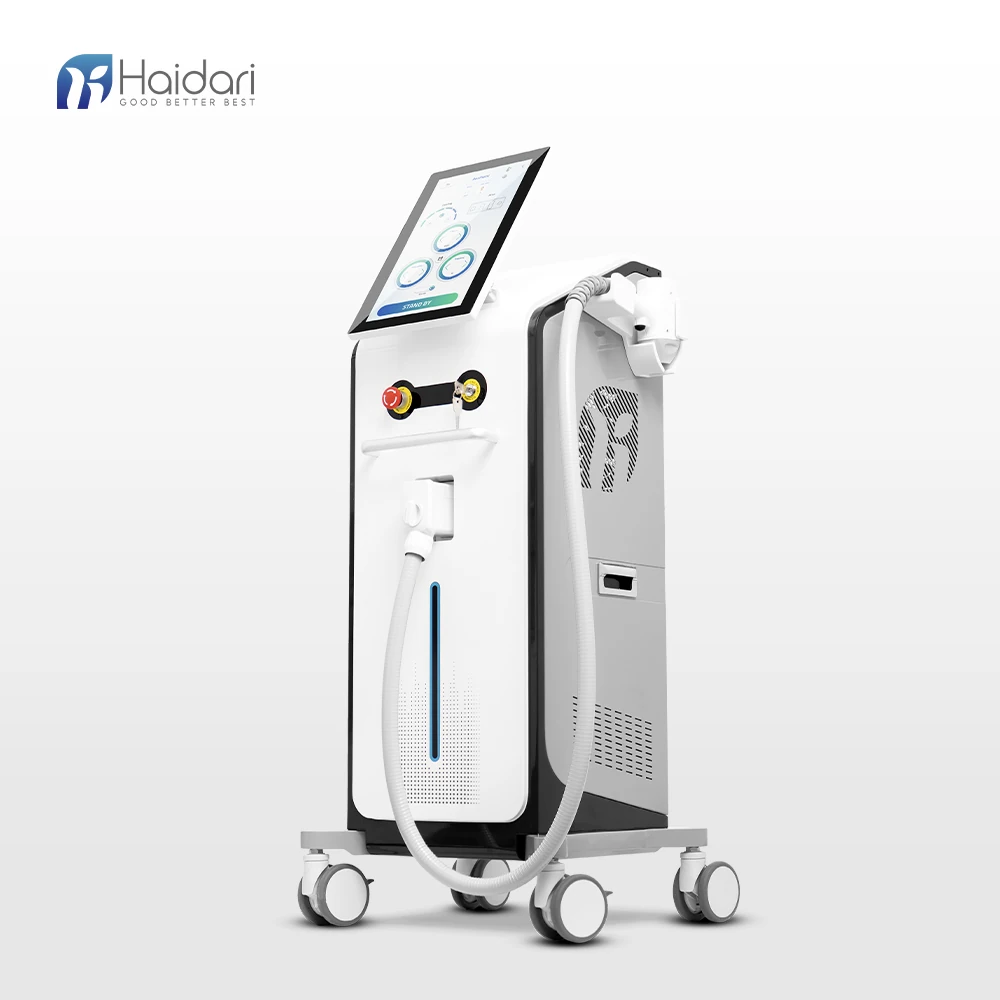
Its specifications include 755 nm, 808 nm, and 1064 nm wavelength options, an 1800 W handpiece, 4000 W machine output, a pulse frequency of 10 Hz, three interchangeable spot sizes, an Italy-imported water pump, TEC contact cooling, and a rated lifetime of more than 100 million shots.
| Parameter | Stella PRO Specification |
| Wavelengths | 755 nm / 808 nm / 1064 nm |
| Laser Source | USA Coherent Laser Bars |
| Handpiece Power | 1800 W |
| Machine Output | 4000 W |
| Pulse Frequency | 10 Hz |
| Spot Sizes | 12 × 12 mm / 12 × 24 mm / 12 × 36 mm |
| Cooling System | Italy-imported water pump + TEC contact cooling |
| Rated Lifetime | 100+ million shots |
| Customization | ODM/OEM support |
Wavelength and Spot Size Configuration
The three wavelength options provide flexibility for different treatment requirements. The available 755 nm, 808 nm, and 1064 nm configurations correspond to commonly used wavelength ranges in laser hair removal, with wavelength selection depending on patient characteristics and treatment protocols.
The machine also provides three interchangeable spot sizes. The 12 × 12 mm tip is suited to smaller areas, while the 12 × 24 mm and 12 × 36 mm options provide broader coverage for larger treatment areas.
Cooling and Continuous-Operation Design
The Stella PRO combines an Italy-imported water pump with TEC contact cooling. The water pump is used for internal cooling circulation, while TEC technology provides contact cooling at the treatment tip.
This combination is designed to support thermal management during treatment and maintain cooling at the skin-contact point. For clinics with frequent appointments, the cooling configuration is an important part of evaluating the machine’s suitability for daily workflow.
OEM/ODM Options
For distributors and brand owners, customization can be an important purchasing factor. The Stella PRO provides full ODM/OEM support, providing an option for buyers who need customized branding or configurations for their target market.
Haidari also has more than 20 years of manufacturing experience, more than 50 R&D engineers and annual production above 6,000 units. It conducts quality-control testing before shipment and works with clinics, beauty salons, distributors, and brand agents.
FAQ
What wavelength is best for a diode laser hair removal machine?
Wavelength selection should take skin type, hair characteristics, treatment area, and the machine’s operating parameters into account. Common professional systems use wavelengths around 800–810 nm, while 755 nm and 1064 nm may also be used for different treatment needs.
Is higher wattage always better for a diode laser?
No. Wattage is only one part of machine performance. Pulse frequency, fluence, pulse duration, spot size, cooling, and output stability also affect how a system operates. A higher wattage figure should therefore be evaluated together with the other technical specifications.
What spot size should I choose for a diode laser hair removal machine?
The answer depends on the treatment areas. Smaller spot sizes are generally more practical for precision work on small areas, while larger spot sizes can improve coverage on broad body areas. A machine with several spot-size options can provide more flexibility.
Why is cooling important in a diode laser hair removal machine?
Cooling helps control heat at the treatment area and can improve patient comfort. It is particularly important when a machine is used for repeated treatments because thermal management can affect both the treatment experience and system operation.
How long does a diode laser handpiece last?
The rated lifetime varies by machine and manufacturer. Buyers should check the stated shot count as well as warranty coverage, replacement cost, and handpiece availability. A high shot-count specification is most useful when the supplier can clearly explain what it represents.
Conclusion
A diode laser hair removal machine should be evaluated as a complete system. Wavelength determines the range of treatment options, power and pulse frequency influence energy delivery and workflow, spot size affects coverage, cooling supports thermal management, and handpiece lifetime can influence long-term ownership costs.
For B2B buyers, the most useful comparison is based on clear technical specifications and verifiable supporting information. Looking beyond headline wattage and purchase price can make it easier to identify a machine that matches the clinic’s treatment volume, patient population, and operating requirements.
For more information about the Stella PRO diode laser hair removal machine, contact Haidari Beauty for detailed specifications and a quotation.