What Is Non-ablative Fractional Laser Resurfacing? How It Works, What It Treats, and What to Expect
Key Takeaways
- Non-ablative fractional laser resurfacing heats selected microscopic areas of the dermis while leaving surrounding tissue intact, supporting collagen remodeling with less downtime than ablative resurfacing.
- Fractional delivery creates microscopic treatment zones rather than treating the entire surface at once, so untreated tissue can support the healing process.
- A 1550 nm erbium-glass laser wavelength is widely used for dermal remodeling and is a common choice for acne scars, fine lines, enlarged pores, rough texture, and photoaging.
- Results develop gradually because collagen remodeling continues after treatment. Clinics commonly plan a series of sessions rather than expecting a single treatment to provide the full result.
- Device selection involves more than wavelength. Energy control, spot-size options, depth control, cooling, duty cycle, service support, and training all affect clinical usability.
What Is a Non–ablative Fractional Laser?
A non-ablative fractional laser treats the skin with controlled heat without intentionally removing the outer skin layer across the treatment area. “Non-ablative” means the epidermis, the outermost layer of skin, remains substantially intact. “Fractional” means the laser treats microscopic columns or zones while leaving untreated areas between them.
This approach sits between very light surface treatments and fully ablative resurfacing. Ablative lasers remove or vaporize portions of the epidermis and can reach deeper tissue, producing stronger resurfacing but usually requiring more recovery. Non-ablative fractional treatment relies primarily on controlled dermal heating, so clinics can address remodeling-related concerns with a shorter recovery period.
How Does Non-Ablative Fractional Resurfacing Work?
Microscopic Treatment Zones and the Healing Cascade
Fractional laser delivery divides the treatment into many microscopic treatment zones (MTZs). In a typical 1550 nm treatment, laser energy passes through the epidermis and creates narrow columns of thermal injury in the dermis, the deeper layer of skin that contains collagen, elastin, blood vessels, and other structural components.
The surrounding untreated tissue remains intact. These tissue bridges act as reservoirs for repair, allowing the skin to recover from the treated zones more efficiently than if the entire surface were exposed to the same thermal injury.
The controlled injury starts a wound-healing response. Inflammation signals repair activity, fibroblasts become active, and the skin begins producing and reorganizing collagen and elastin. Collagen remodeling refers to the gradual breakdown, replacement, and reorganization of collagen fibers. Neocollagenesis means the formation of new collagen, while elastogenesis refers to new elastin production.
Why the 1550 nm Wavelength Is the Standard Choice
The 1550 nm wavelength has a long clinical history in non-ablative fractional resurfacing because water absorbs this wavelength sufficiently to create controlled thermal effects in the dermis. Skin contains a high proportion of water, so the laser can deliver heat to targeted tissue without relying on broad epidermal removal.
A 1550 nm erbium glass laser is therefore commonly used when the treatment objective is dermal remodeling with limited surface disruption. Treatment parameters such as pulse energy and coverage can be adjusted so clinicians can tailor treatment intensity to the patient’s skin condition, treatment area, and tolerance.
What Can Non-Ablative Fractional Resurfacing Treat?
Acne Scars and Textural Damage
Atrophic acne scars are depressions created when acne-related inflammation damages the dermal structure. Fractional heating can stimulate collagen remodeling around these irregular areas, gradually improving the appearance of uneven texture.
Treatment planning depends on scar type, depth, location, skin type, and the patient’s tolerance for downtime. Rolling, shallow boxcar, and other atrophic scars may respond differently, so parameter selection should follow clinical assessment rather than a single preset.
Non-ablative fractional treatment can also be useful when a clinic wants to address general textural irregularity alongside acne scars. Because the treatment creates microscopic zones rather than removing the entire epidermal surface, recovery is generally more manageable than with fully ablative resurfacing.
Fine Lines, Pores, Pigmentation, and Stretch Marks
Common treatment indications and areas of interest include:
- Atrophic acne scars
- Fine lines
- Enlarged pores
- Rough or uneven texture
- Pigmentation and photoaging
- Melasma when conservative protocols are appropriate
- Surgical scars
- Striae, commonly called stretch marks
The same wavelength can produce different clinical effects depending on energy, coverage, treatment depth, and the condition being treated. Pigmentary conditions require particular care because inflammation can sometimes contribute to post-inflammatory hyperpigmentation. Melasma is especially treatment-sensitive and should be managed conservatively with appropriate sun protection and clinical judgment.
Treatment Experience, Recovery, and Results
Who Is It For?
A suitable candidate is generally someone whose treatment concern can benefit from dermal remodeling and who understands that improvement develops over multiple weeks. Common concerns include acne scarring, fine lines, enlarged pores, uneven texture, and selected signs of photoaging.
Fitzpatrick skin type, which classifies skin according to its tendency to burn or tan after ultraviolet exposure, is relevant to treatment planning. Non-ablative treatment can be considered across a broad range of skin types, but darker skin requires careful parameter selection because excessive inflammation or heat can increase the risk of pigmentary changes.
Patients often choose non-ablative fractional resurfacing when they want gradual improvement while keeping downtime relatively limited. A patient’s medical history, active skin conditions, medications, previous procedures, and tendency toward abnormal scarring should also be reviewed before treatment.
Recovery and Results Timeline
A typical treatment pathway may include:
- During treatment: Topical numbing may be used depending on treatment intensity and patient tolerance. Appropriate eye protection is required.
- First 1–3 days: Redness and swelling are common and generally settle during the early recovery period.
- Following several days: Some patients develop bronzing, fine grid-like marks, or mild flaking as treated tissue clears.
- Treatment series: Clinics commonly plan around 3–5 sessions, with roughly 2–4 weeks between sessions depending on the indication and protocol.
- 8–12 weeks: Collagen remodeling continues, so texture and firmness changes may become more visible gradually.
- Throughout the course: Sun protection is important because ultraviolet exposure can worsen inflammation and pigmentation risk.
Actual recovery varies with energy, coverage, treatment area, skin type, and individual healing response. Clinical protocols should determine the appropriate interval and settings for each patient.
Non-Ablative vs. Micro-Ablative vs. Ablative Resurfacing
These categories describe how much tissue is intentionally disrupted and how deeply the treatment acts. They overlap in clinical use, but their recovery profiles and treatment intensity differ.
| Feature | Non-Ablative (e.g., 1550 nm) | Micro-Ablative (e.g., 1927 nm) | Ablative (e.g., CO2/Er) |
| What happens to the epidermis | Largely preserved | Microscopic controlled ablation in treated zones | Significant epidermal removal or vaporization |
| Treatment depth | Primarily dermal thermal remodeling | Superficial to fractional epidermal and dermal effects | Can reach deeper resurfacing layers |
| Typical downtime | Low; often a few days of visible redness or swelling | Usually several days, depending on settings | Often longer, with more substantial wound care |
| Number of sessions | Often a series | Often a series, depending on indication | May require fewer sessions for some concerns |
| Strongest indications | Texture, fine lines, acne scars, pores, selected photoaging | Pigmentation, texture, superficial resurfacing | More pronounced resurfacing, deeper wrinkles, selected scars |
| Best-fit patient | Patients prioritizing gradual improvement and limited downtime | Patients needing stronger surface treatment with controlled recovery | Patients accepting greater recovery for more intensive resurfacing |
What Matters in a 1550 nm Laser Machine
For clinics and distributors evaluating an erbium glass laser, specification literacy helps separate meaningful treatment controls from headline numbers. Output power matters, but it should be considered together with pulse-energy control, spot size, treatment depth, cooling, and how the system handles repeated treatments during a working day.
Useful specification checks include:
- Output power and whether it supports the intended treatment workload
- Adjustable pulse-energy range and the size of each adjustment step
- Interchangeable spot sizes or treatment tips for different anatomical areas
- Depth control and whether the system supports clearly defined treatment layers
- Non-ablative and mild-ablative operating options, where clinically appropriate
- Cooling performance and temperature management
- Duty cycle and thermal stability during repeated treatments
- Electrical and regulatory certifications relevant to the target market
- Warranty terms and availability of replacement parts
- Technical support, clinical training, manuals, and protocol guidance
- OEM/ODM options when distributors need customized interfaces, branding, or configurations
A useful specification sheet should allow the clinical team to understand how each control changes treatment delivery. For distributors, serviceability and documentation matter alongside the laser specifications because the equipment must remain practical after installation.
Meet the Gentlefrax 1550 nm Fractional Fiber Laser
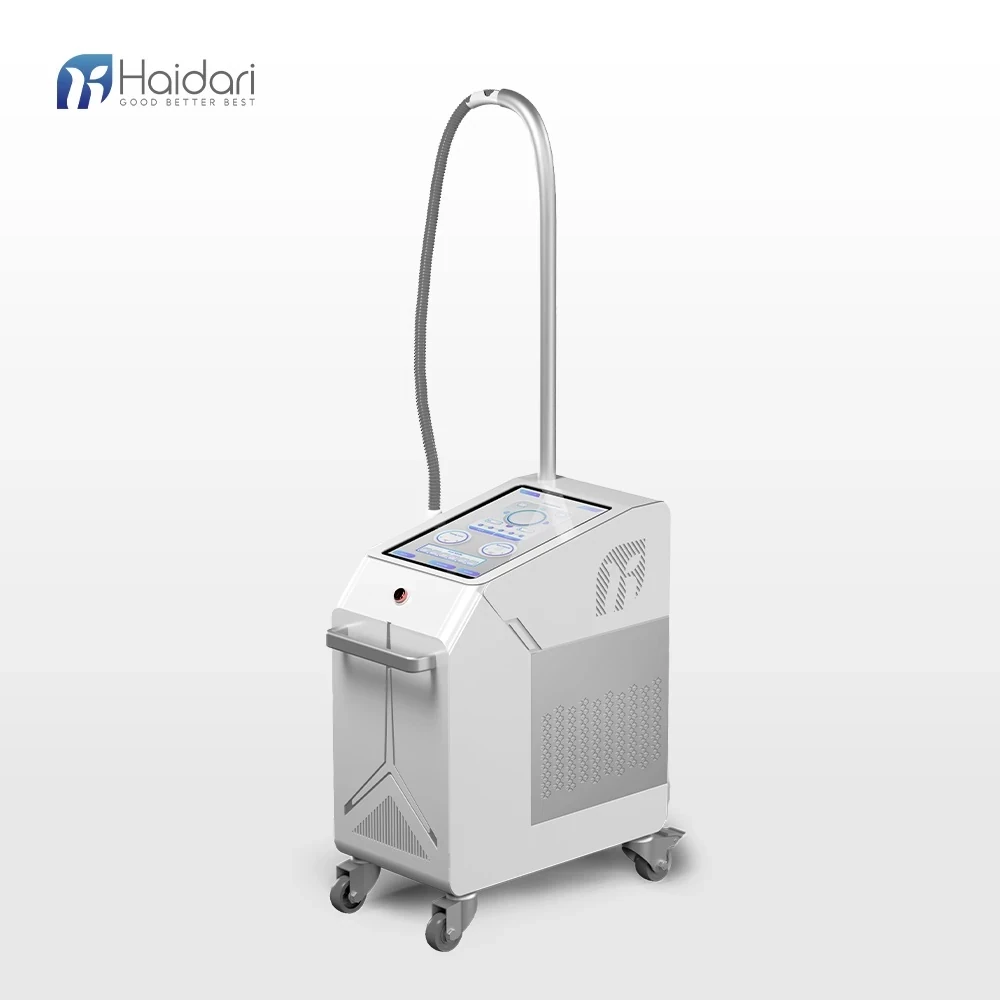
Gentlefrax is a single-wavelength 1550 nm fractional fiber laser platform designed for both non-ablative dermal remodeling and mild-ablative epidermal resurfacing. Its adjustable energy range lets clinicians tailor the treatment effect to the selected mode and clinical objective.
One Platform, Two Treatment Depths
At lower energy settings, Gentlefrax stimulates neocollagenesis and elastogenesis while preserving the epidermal barrier. At higher energy settings, the system can provide mild-ablative epidermal resurfacing for superficial pigmentation and surface irregularities.
The interchangeable 5 mm, 10 mm, and 20 mm handpieces are intended for different treatment areas. The 5 mm option is suited to precision work around delicate areas such as the eyes and mouth. The 10 mm option provides balanced facial coverage, while the 20 mm option is designed for larger areas such as the chest, neck, and hands.
Gentlefrax Specifications at a Glance
| Specification | Gentlefrax |
| Wavelength | 1550 nm (Er:Glass) |
| Laser Type | Fractional ER-Fiber |
| Output Power | 30 W |
| Pulse Energy | 2–120 mJ (continuously adjustable) |
| Handpiece Options | 5 mm, 10 mm, 20 mm (customizable) |
| Treatment Depth | Adjustable (epidermal to deep dermal) |
| Treatment Modes | Non-Ablative / Mild Ablative |
| Target Tissues | Dermis + Epidermis |
Why Clinics and Distributors Work with Haidari
Haidari Beauty Technology has more than 20 years of laser device R&D and manufacturing experience. The company holds ISO 13485:2016, FDA, Medical CE, and EMC certifications, along with more than 50 R&D engineers and annual production capacity exceeding 6,000 units.
Haidari offers deep hardware and software customization, including interface design, multilingual support, branding, and packaging. The company also provides online training materials and can arrange professional clinical training sessions. Haidari provides 24/7 online technical response and a 5-year warranty on core parts.
Frequently Asked Questions
How many non-ablative fractional laser sessions do patients typically need?
Many treatment plans use a series of about 3–5 sessions, with the interval selected according to the indication, treatment intensity, and the patient’s recovery. The exact number should be determined after clinical assessment rather than treated as a fixed course for every patient.
Is non-ablative fractional resurfacing safe for darker skin types?
It can be considered for darker Fitzpatrick skin types, but conservative parameter selection is important because inflammation and thermal injury can contribute to pigmentary changes. Patient history, treatment indication, energy, coverage, and sun exposure should all be considered when planning treatment.
What is the difference between non-ablative and ablative fractional lasers?
Non-ablative fractional treatment primarily creates controlled thermal injury beneath an intact epidermis. Ablative fractional treatment intentionally removes microscopic columns of epidermal or dermal tissue. Ablative treatment can produce stronger resurfacing effects but generally involves more recovery and wound-care requirements.
What is the downtime after a 1550 nm erbium glass treatment?
Downtime depends on treatment settings and the patient’s response. Mild redness and swelling may last around 1–3 days, while bronzing or fine grid-like marks can persist as the treated skin flakes off. More intensive settings can extend recovery.
Does non-ablative fractional resurfacing hurt, and how should patients prepare?
Treatment can cause heat, stinging, or discomfort, and topical numbing is often used according to the protocol and patient’s tolerance. Patients should follow the clinic’s preparation instructions, disclose relevant medications and skin conditions, use appropriate eye protection during treatment, and maintain careful sun protection before and after the procedure.
Conclusion
Non-ablative fractional resurfacing uses controlled microscopic thermal zones to stimulate dermal remodeling while preserving surrounding tissue. The 1550 nm wavelength has an established role in this approach, particularly for texture, acne scars, fine lines, pores, and selected photoaging concerns. For clinics and distributors, understanding energy control, treatment depth, spot size, recovery, and service requirements provides a practical basis for evaluating equipment. If you are considering Gentlefrax for your clinic or distribution portfolio, request a quote from Haidari Beauty Technology to discuss the available configuration and support.