
Can One Hair Removal Machine Handle Every Skin Tone? How 808nm and 1064nm Wavelengths Decide
Key Takeaways
- Hair removal lasers target melanin in the follicle, but the same pigment sits in the epidermis, so skin tone decides how much energy reaches the target and how much stays in the surface layer.
- 808nm is the practical middle ground for Fitzpatrick I to IV. It is a starting point, not a universal setting.
- 1064nm gives up absorption strength in exchange for depth and selectivity, which makes it the better wavelength on types V and VI, at the cost of higher fluence and a weaker response on fine, light hair.
- 755nm still earns its place on fine, light hair over lighter skin, although it carries the narrowest safety margin of the three.
- A mixed patient base rarely points to a single-wavelength machine. It points to one where the wavelength can be configured.
Why Skin Tone Changes the Treatment, Not Just the Settings
A diode laser fires light that melanin absorbs well. In the follicle, that light becomes heat, and the heat has to reach a level that stops the follicle from producing another hair. The chain of events is identical for every patient and every device.
What changes is the route. Light enters through the epidermis before it reaches the follicle, and the epidermis contains melanin of its own. On light skin the surface takes a small share of each pulse and lets the rest through. On deeper skin, the surface takes a much larger share, so the same energy that heats a follicle on one patient heats the skin surface on another.
Lowering the energy solves the safety problem and creates a results problem, because the follicle no longer reaches its threshold. This is why wavelength choice is structural rather than cosmetic. It changes how much competition the light meets before it reaches the target.
What Fitzpatrick Type Really Measures
The Fitzpatrick scale from I to VI describes how skin responds to ultraviolet light, specifically whether it burns or tans and how quickly. It was never designed as a color chart, and two patients with a similar complexion can sit in different types if one burns easily and the other tans.
For laser work, the scale is useful as a proxy for epidermal melanin density and reactivity, which is exactly what decides how much heat the surface absorbs during a pulse. A type II patient will usually tolerate more fluence at 808nm than a type V patient does, because less of the beam is lost at the surface.
Treat the type as a ceiling on energy, not as a label. That single adjustment in how the number is read prevents most of the avoidable injuries in this field.
Where 808nm Works and Where It Stops
808nm sits at a useful compromise. Water absorbs very little at this wavelength, so the beam reaches the follicular bulb at three to five millimeters, and melanin absorption stays strong enough to heat the follicle quickly. That balance explains why so many clinics build their body work around an 808nm diode laser hair removal machine rather than a shorter wavelength.
The same balance is the limitation. Fitzpatrick V and VI skin holds enough epidermal melanin to absorb a meaningful share of every pulse. Raise the fluence to compensate and the surface heats faster than the follicle; lower it and the treatment underperforms. Experienced operators work around this with longer wavelengths, longer pulse durations, stronger cooling and conservative energy, which is why one fixed setting cannot serve a diverse clinic well.
The table below maps the three wavelengths that matter in routine diode work.
| Wavelength | Absorption and reach | Skin types it suits best | Where it runs into trouble |
| 755 nm | Highest absorption, shallowest reach | I to III, fine and light hair | Surface heat on tanned or deeper skin |
| 808 nm | Moderate to high, 3 to 5 mm deep | I to IV | Epidermal competition on types V and VI |
| 1064 nm | Lowest absorption, deepest reach | IV to VI | Needs higher fluence; weaker on fine, light hair |
Read it as a starting map. Pulse duration, spot size, cooling and the hair itself move every row.
The 1064nm Answer for Deeper Melanin
A 1064nm diode laser hair removal machine trades absorption strength for depth and selectivity. Melanin absorbs less at this wavelength, so the epidermis claims a smaller share of each pulse and more energy reaches the follicle without pushing the surface toward injury. Nothing about the mechanism changes; only the division of energy between surface and target changes.
The trade-off is honest and worth stating plainly to a buyer. Lower absorption means higher fluence and often longer pulse widths to reach the same follicular temperature, and fine, light hair responds less predictably than coarse, dark hair does.
Longer Wavelength, Less Competition From Epidermal Melanin
Melanin absorption falls as wavelength rises, while water absorption stays low until the beam moves well beyond the near-infrared. Between roughly 800 and 1100 nanometers, that combination produces the deepest useful reach with the least surface uptake, which is why 1064nm has become the default starting point on deeper skin.
The practical consequence is a wider safety margin rather than a stronger effect. On type V and VI skin, a clinic can treat at energies that would be reckless at 808nm, and still needs to start conservatively, test a small area and stretch intervals. Sun exposure in the weeks before a session behaves like a deeper skin type and should change the plan, not just the dial.
Cooling Decides Whether a Wavelength Is Safe in Practice
Wavelength decides how much heat the surface absorbs. Cooling decides whether the surface tolerates it. Sapphire contact cooling holds the epidermis at a low, stable temperature before, during and after each pulse, which buys the operator room to deliver useful energy without leaving a mark.
When cooling drifts, two failures follow. Operators either lower the energy until the treatment is comfortable but ineffective, or they push through and accept redness that settles into pigment change weeks later. Neither shows up in a quotation, and both show up in reviews.
Three details separate real cooling from a claim that only looks good on paper.
- Temperature stability under continuous use, not the reading at the start of the day.
- Contact area and pressure at the tip, because cooling only works where the sapphire actually touches skin.
- Recovery time between patients, since a system that needs long cooldowns quietly caps daily volume.
755nm Still Has a Job: Fine and Light Hair
Of the three, 755nm is absorbed most eagerly by melanin, which makes it fast and effective on fine, light hair over lighter skin, and it is often the wavelength that finally shifts a case other settings could not reach.
That same appetite is the problem. The margin between a working pass and an epidermal injury is the narrowest of the three, and it shrinks further on tanned or deeper skin, where the surface competes for the beam almost as strongly as the follicle does. On a mixed patient base, 755nm works best as a third wavelength brought in for specific cases rather than as the foundation of the treatment menu.
Single, Dual or Triple Wavelength: The Real Trade-off
Adding wavelengths adds cost, optics and decisions. A dual platform, almost always 808nm plus 1064nm, sits between the two extremes: it covers the common mix without the 755nm channel, and it is the cheapest way to stop turning away deeper skin. Whether a third wavelength pays for itself depends on two numbers a clinic already knows: how many clients fall outside the safe range of 808nm, and how many of those are currently turned away or referred elsewhere.
- Capital cost. Each additional wavelength needs its own diode stack and beam-combining optics, so the handpiece becomes the most expensive part of the build.
- Energy per channel. Multi-wavelength handpieces divide output across channels, which makes total handpiece power more important than the number of wavelengths on the label.
- Operator load. More options mean more protocol choices, and without training the extra wavelengths sit unused while every client is treated at the default setting.
- Patient coverage. A 3 wavelength diode laser hair removal configuration keeps type V and VI clients in your own booking book instead of sending them down the road.
There is a simpler way to settle the question. Count the consultations you declined last year for skin type or recent tanning, then decide whether that number justifies a wider handpiece.
What This Means for a Mixed Patient Base
Put those four points together and they reduce to one purchasing rule: read the patient mix first, then read the parameter list. Everything else in a quotation is secondary to whether the wavelength can follow the people in the chair.
Read Your Booking Mix Before You Compare Configurations
A rough threshold works well enough for planning. Where clients with type IV to VI skin, or a recent tan, make up more than a fifth of bookings, 1064nm stops being optional. Where bookings are dominated by types I to III and the goal is daily volume, 808nm with a large spot and stable cooling covers the work. Most clinics sit between those two positions, and that is precisely the case a configurable platform was built for.
Ask three questions before any demonstration. Which skin types appear in a normal week, in roughly what proportion? Which areas dominate, since faces and legs pull the design in different directions? And how many treatments a day must the room support without a cooldown break?
Three Spot Sizes, One Handpiece
Spot size decides how the work feels in practice. A 12 by 12 millimeter tip handles upper lip, chin, fingers and shaping work; a 12 by 24 millimeter tip covers full face, underarm and bikini line; a 12 by 36 millimeter tip turns legs, back, chest and abdomen into a single pass routine instead of a slow sweep.
Interchangeable tips on one handpiece matter more than they sound. The operator changes the tip rather than the machine, so a booking for lip and a booking for full legs sit in the same day without recalibration between them, and delivered energy stays consistent across the two.
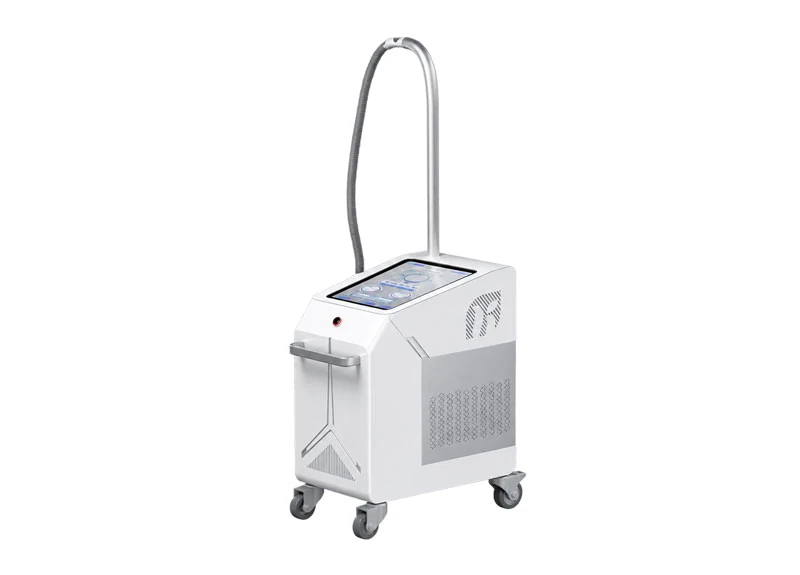
How the Stella PRO Is Configured for This
The Stella PRO follows the logic above rather than working against it. Wavelength runs to 755nm, 808nm and 1064nm as an optional configuration, so a clinic can order the coverage its patient mix actually needs. The laser bars come from Coherent in the United States, the handpiece delivers 1800W against 4000W of machine output, and pulse frequency reaches 10Hz for body work.
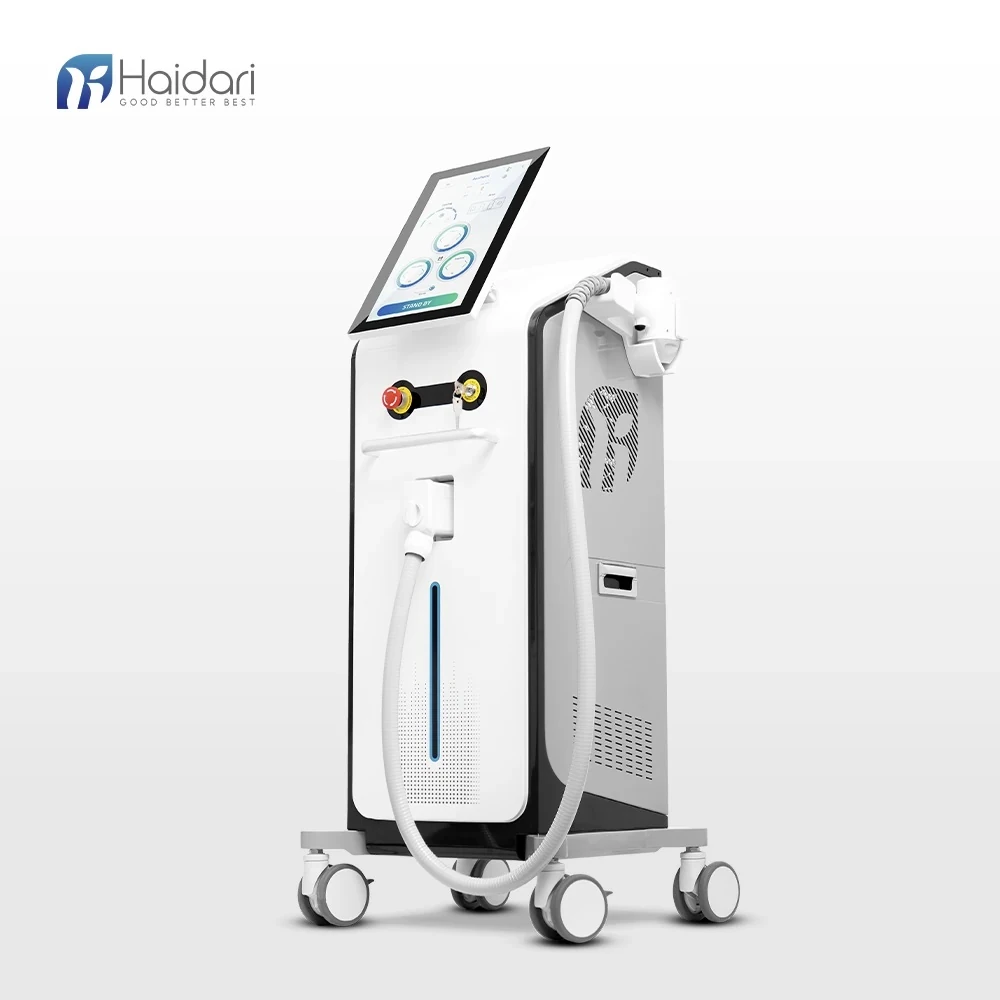
Cooling combines an imported Italian water pump with TEC contact cooling, and the handpiece is rated for more than 100 million shots. Those two numbers decide the economics of a busy room: stable temperature through back-to-back appointments, and a handpiece that does not become a consumable within a couple of years.
For a clinic serving more than one skin type, the point is that wavelength follows the patient, spot size follows the area, and cooling follows the schedule. That is what separates a professional laser hair removal machine used as a platform from one used as a single-purpose tool.
Distributors have a second reason to look at the platform: it supports full ODM and OEM work, from branding through to configuration.
| Technical data | Stella PRO |
| Wavelength configuration | 755 nm / 808 nm / 1064 nm (optional configuration) |
| Laser source | Coherent laser bars, United States |
| Handpiece power | 1800 W |
| Machine output | 4000 W |
| Pulse frequency | 10 Hz |
| Spot sizes | 12 x 12 mm / 12 x 24 mm / 12 x 36 mm, interchangeable |
| Cooling | Imported Italian water pump with TEC contact cooling |
| Handpiece lifetime | 100+ million shots |
| Customization | Full ODM / OEM support |
Frequently Asked Questions
Is 1064nm safe for Fitzpatrick type VI skin?
Safer, not risk-free. The wavelength limits how much energy the epidermis claims, but it does not remove the need for a test area, conservative opening fluence, stable cooling and intervals long enough for skin to recover. Recent sun exposure should be treated as a reason to reschedule rather than a detail to work around.
Can an 808nm-only machine treat darker skin at all?
Yes, within narrower limits. Treatment relies on lower fluence, longer pulse durations, stronger cooling and more sessions, and the margin between a useful pass and an injury stays thin. On a patient base that includes many type V and VI clients, that margin becomes the argument for a second wavelength.
How many sessions should a clinic plan for?
Six to eight sessions at four to six week intervals is a normal working range, and most patients see 70 to 90 percent reduction by the end of a full course. Hormonal conditions, area, hair density and treatment regularity all move that number, so quote a range rather than a promise.
Does a higher power rating always mean better results?
No. Power governs speed and how much energy survives across a large spot, which matters on legs and backs. The result itself comes from the combination of wavelength, pulse duration, spot size and cooling. A well-matched mid-power system routinely outperforms a high-power one pointed at the wrong wavelength.
What should a clinic check before adding a third wavelength?
Two things: how many clients were refused or referred elsewhere because of skin type last year, and whether the operators will actually change protocols per patient. Without the first, the extra wavelength is unused capacity. Without the second, it is an expensive default setting.
Conclusion
Whether one machine can handle every skin tone comes down to a single question: can the wavelength change as the patient changes? At 808nm, most lighter and medium skin types treat quickly and comfortably. At 1064nm, deeper skin types gain the margin they need, in exchange for more energy and more patience. At 755nm, fine and light hair gets its best chance, on skin that can spare the absorption. Cooling is what lets all three function inside a real appointment book.
Buyers who work through that logic in this order tend to end up with fewer machines and fewer refusals: patient mix first, wavelength coverage second, power and spot size third.
Send us your booking mix, the skin types you see in a normal week, the areas you treat most and the number of appointments your room has to hold, and we will tell you which configuration fits it and which parts you can leave out.