
Fractional CO₂ Laser Technology: What It Offers and How to Choose
Key Takeaways
- A fractional CO₂ laser reshapes skin by creating thousands of microscopic columns of heat, with far shorter recovery than older ablative devices.
- Output power, pulse energy, pulse mode, and cooling decide most of the clinical difference between machines.
- One platform can address acne scars, wrinkles, sun damage, and rough texture with adjustable depth.
- Results build slowly, so the skin keeps improving for months after the final session.
- Verify certification, service support, and pulse flexibility before you commit to a purchase.
Fractional CO₂ resurfacing has become one of the most requested treatments in aesthetic medicine, and the machines behind it vary more than their prices suggest. For a clinic owner or distributor, the real challenge is choosing a device that delivers consistent results today and stays reliable for years. This guide explains how the technology works, which numbers on a data sheet actually separate strong machines from average ones, and what to check before you sign a purchase order. Buyers researching a Korean fractional CO₂ laser or an alternative from another origin will find the same framework applies.
What Is a Fractional CO₂ Laser?
A CO₂ laser emits infrared light at 10,600 nanometers, a wavelength that water absorbs extremely well. Because skin is rich in water, the beam heats tissue quickly and precisely. The earliest CO₂ lasers vaporized the entire treatment surface, which produced impressive results but demanded weeks of recovery. Fractional technology changed the equation. Instead of treating every square millimeter, the beam is divided into thousands of tiny columns, so each pass treats only a fraction of the skin.
How the Technology Works
Each column creates a microscopic treatment zone, a small plug of heated tissue surrounded by intact skin. Those intact bridges speed healing and supply the cells that rebuild the area. As the treated zones recover, the skin launches a wound-healing response that lays down new collagen and elastin over the following weeks and months. That slow, steady remodeling is why results keep improving long after the visible redness fades.
Because the skin heals from the edges of every zone, downtime stays manageable. Patients typically see several days of redness and light peeling rather than the open, crusted surface that older resurfacing produced. This balance between results and recovery is the core reason fractional CO₂ remains relevant after decades of newer technologies.
Key Parameters That Separate Good Machines from Average Ones
Not every fractional CO₂ device behaves the same. Four or five numbers on a data sheet decide most of the difference, and they are easy to compare once you know what they mean.
Table 1 Key parameters of fractional CO₂ laser machines
| Parameter | What It Does | Why It Matters |
| Output power (W) | Drives how quickly and evenly a large area is treated | A 30 W machine keeps full-face sessions practical |
| Pulse energy (mJ) | Sets the depth and intensity of each micro-column | Deep atrophic scars usually need higher energy per pulse |
| Pulse mode | Controls how long tissue stays hot with each shot | Super-pulse and ultra-pulse modes reduce charring and downtime |
| Spot size and scan pattern | Defines the treated area per pass and the uniformity of coverage | Even coverage produces consistent results across the face |
| Contact cooling | Protects the epidermis while deeper layers are heated | Improves comfort and lowers the risk of side effects |
Certification deserves a line of its own. Reputable fractional CO₂ laser equipment carries verifiable documentation: CE marking for the European market, FDA clearance where the target market requires it, and certification aligned with ISO 13485. Documents you can check are worth more than any brochure promise, because they prove the device was designed and tested under a real quality framework.
When you compare a CO₂ fractional laser machine against its rivals on these numbers, the picture is clearer than any marketing story. A device with adjustable energy, a true pulsed mode, and a documented cooling system usually outperforms a cheaper unit that wins on price alone.
Common Uses in a Modern Clinic
Fractional CO₂ resurfacing has earned a place in most aesthetic practices. The most common targets are:
- Atrophic acne scars, especially rolling and boxcar types, because the laser remodels scar tissue layer by layer
- Fine lines and wrinkles around the eyes and mouth, where collagen loss becomes visible first
- Sun-damaged skin and rough texture, which respond to repeated, moderate sessions
- Enlarged pores, which appear tighter after gentle fractional settings
- Surgical and trauma scars, which improve with lower energy and multiple passes
Most patients need three to five sessions spaced six to eight weeks apart. The skin continues to improve for months after the final treatment, so clinics often present the plan as a course rather than a single visit.
What to Check Before You Commit
A data sheet is a starting point, not a verdict. Before signing, most experienced buyers run the same five checks:
- Ask for a live demonstration. Watch the machine run at low and high energy, and confirm that the output stays stable across a full session.
- Verify the paperwork. CE marking, FDA clearance where required, and ISO 13485 certification should be backed by documents you can request and read.
- Review the training material. A device is only as good as the team operating it, so clear manuals and practical training matter more than glossy claims.
- Test the service response. Ask about spare parts availability, typical repair turnaround, and whether the supplier can support your region.
- Count the total cost. Tube lifetime, maintenance intervals, and consumables can change the real price more than the initial quote does.
Many buyers begin their sourcing with a region in mind, such as fractional CO₂ laser South Korea, but the label alone says little about how a device performs. The checks above apply to every candidate, whatever its origin.
A Machine Worth Comparing: the FONS-SVR 10600nm
Once the evaluation criteria are clear, it helps to look at a concrete platform. The FONS-SVR 10600nm is a fractional CO₂ machine built on imported Korean technology, part of a product line focused on deep resurfacing and scar revision.
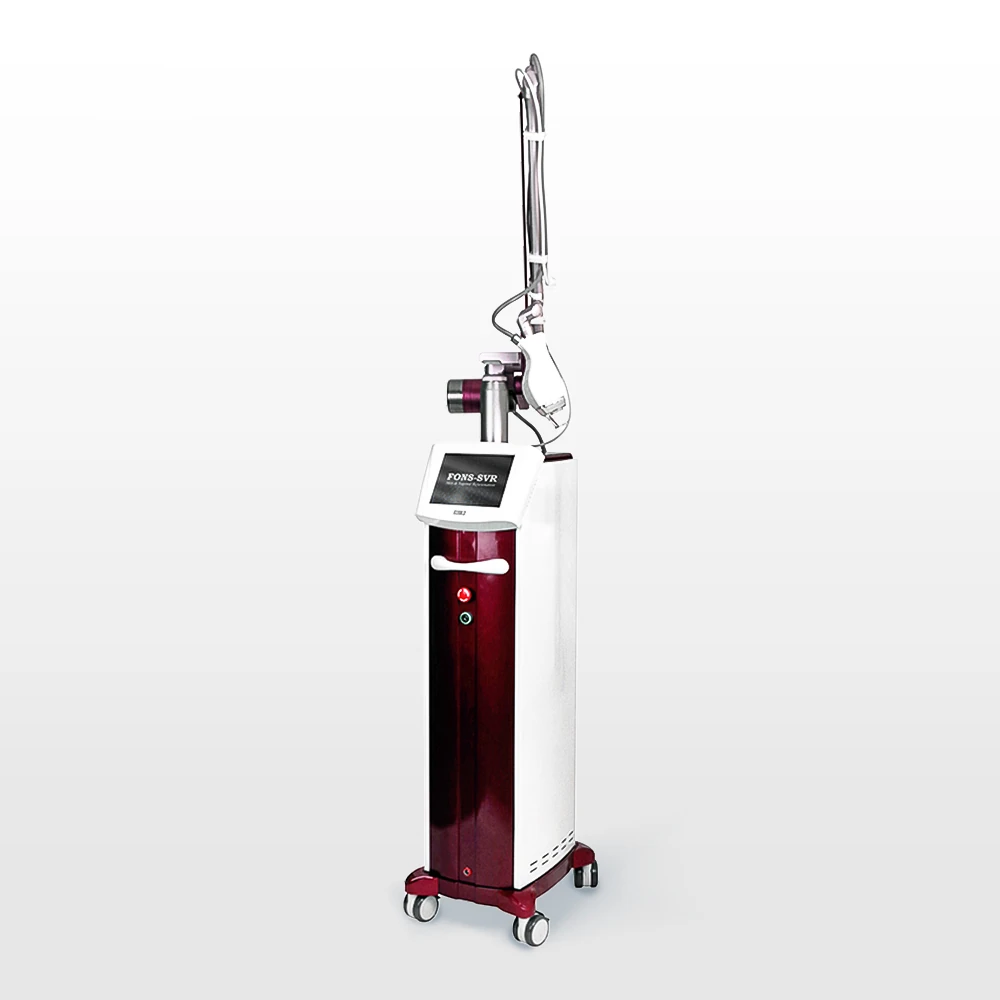
Distributors sourcing a fractional CO₂ laser Korea typically narrow the field to three or four platforms, and the FONS-SVR keeps appearing on those shortlists. Its parameters cover shallow resurfacing and deep scar work in one cabinet, which simplifies both training and inventory.
Built for Deep Resurfacing and Scar Revision
- Wavelength: 10,600 nm CO₂
- Output power: 1–30 W, continuous
- Pulse energy: 1–300 mJ, adjustable
- Pulse duration: 0.05–10 ms
- Output modes: Continuous, Super Pulse, Ultra Pulse
- Treatment modes: Surgical, Fractional, and Vaginal Rejuvenation
- Scan area: X 3–20 mm, Y 3–20 mm, adjustable
- Spot size: 0.2–0.4 mm
The energy range explains its versatility. Low settings suit delicate areas and mild textural work, while high settings reach deep atrophic scars that weaker machines cannot touch. The 1–300 mJ window gives the operator room to match the treatment to the scar, not the other way around.
What the Pulse Modes Mean in the Treatment Room
Super-pulse and ultra-pulse modes shorten each pulse so that heat does not linger in the tissue. Less lingering heat means less charring, less discomfort, and faster re-epithelialization. In daily practice, that translates into a machine that can act aggressively when it needs to and gently when the situation calls for it, all from the same handpiece.
The surgical mode adds another dimension. For a growing practice, that reduces capital cost while expanding the menu of services.
Frequently Asked Questions
How many sessions does fractional CO₂ laser treatment usually take?
Most treatment plans run three to five sessions, spaced six to eight weeks apart. Deep scars may require more, while mild textural work may need fewer. Because collagen remodeling continues for months, the final result appears gradually rather than overnight.
How long is the downtime?
Plan for a few days of redness and mild swelling, with a sandpaper-like texture that peels by the third to fifth day. Most patients return to normal activities within a week, and deeper settings can extend that window. Fractional delivery keeps downtime far shorter than the older full-surface CO₂ treatment.
Is fractional CO₂ laser painful?
The procedure is generally well tolerated. A topical anesthetic is applied beforehand, and contact cooling protects the skin during each pulse. Most people describe the sensation as warmth with brief pinpricks rather than sharp pain.
Can it treat melasma or stubborn pigmentation?
Fractional CO₂ is not the first choice for melasma. The risk of post-inflammatory hyperpigmentation is real, especially on darker skin, and melasma often responds better to gentler devices or combination protocols. For sun damage, age spots, and scar-related discoloration, fractional CO₂ can be effective in the right hands.
How long do the results last?
Results are durable because the skin structure itself is rebuilt. Collagen continues to form for months after the final session, and many clinics schedule a maintenance treatment every six to twelve months to preserve the effect as aging continues.
Conclusion
Fractional CO₂ has matured into one of the most reliable resurfacing tools in aesthetic medicine. A well-chosen machine, with honest parameters, verifiable certification, and dependable support, can anchor a practice’s skin program for years.
If you are comparing suppliers, ask for the full parameter list, watch a live demonstration, and check how the team supports you after the sale. A reputable manufacturer will welcome those questions, because that is exactly the conversation a serious buyer should have.