
Beyond Competition: How Combining 10600nm CO₂ and 1550nm Non-Ablative Lasers Maximizes Clinic ROI
Introduction
As aesthetic clinics continue to expand their treatment services, selecting the right laser platform has become an important business decision. Clinics need equipment that can support different treatment requirements while improving workflow efficiency, space utilization, and long-term investment value.
Many skin concerns involve different layers of the skin and require different laser approaches. Ablative technologies such as 10600nm CO₂ fractional lasers focus on controlled skin resurfacing, while non-ablative technologies such as 1550nm lasers provide another approach for dermal treatment applications.
Traditionally, clinics have purchased separate devices to access these different technologies. However, managing multiple laser systems can increase equipment investment, occupy more treatment space, and add complexity to daily operations.
By combining 10600nm CO₂ fractional laser and 1550nm non-ablative laser technologies in one platform, clinics can achieve greater treatment flexibility while optimizing equipment utilization. This integrated approach provides a practical solution for beauty salons, aesthetic clinics, and dermatology clinics looking to expand their service capabilities.
Understanding the Difference Between Ablative and Non-Ablative Laser Technologies
How 10600nm CO₂ Fractional Lasers Resurface the Skin
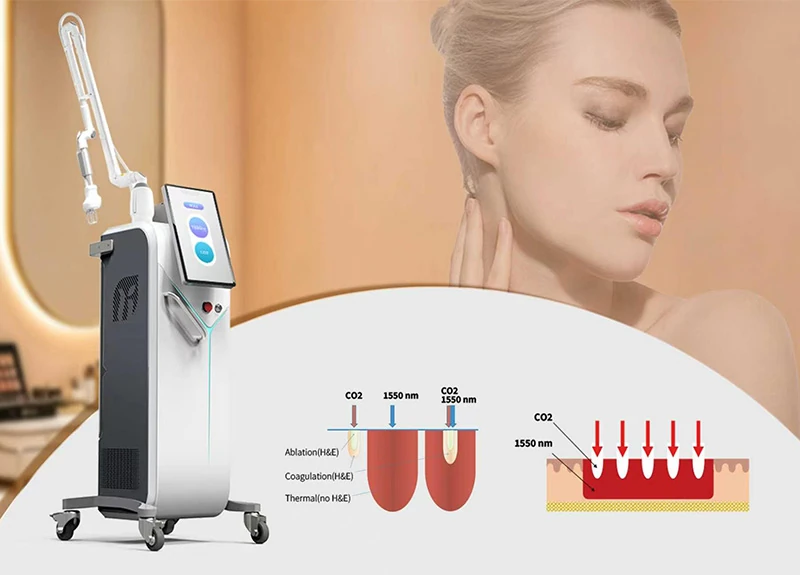
Ablative laser technology works by creating controlled treatment zones in the skin to stimulate the natural regeneration process. The 10600nm CO₂ laser wavelength is strongly absorbed by water molecules, allowing it to precisely target water-rich tissues.
In fractional CO₂ laser treatment, microscopic columns of treated tissue are created while surrounding areas remain intact. This fractional approach helps support skin renewal and collagen remodeling while allowing practitioners to adjust treatment intensity based on patient requirements.
Because it directly affects the skin surface, 10600nm CO₂ fractional laser technology is commonly associated with resurfacing applications, including improving the appearance of fine lines, uneven texture, acne scars, and photoaging-related skin changes.
The main advantage of CO₂ laser technology is its ability to provide intensive resurfacing. However, treatment parameters and recovery expectations need to be carefully considered depending on the patient’s skin condition and treatment goals.
How 1550nm Non-Ablative Lasers Support Dermal Remodeling
Unlike ablative lasers, non-ablative laser systems do not remove surface tissue. Instead, they deliver controlled thermal energy into deeper skin layers while maintaining the integrity of the epidermis.
The 1550nm wavelength is commonly used in non-ablative applications because it can reach the dermal layer where collagen remodeling processes take place.
Compared with ablative procedures, non ablative laser treatment generally provides a gentler approach with less surface disruption. This makes it suitable for clinics that want to offer skin improvement options with different recovery expectations.
It is commonly used in aesthetic programs focusing on collagen stimulation, skin texture improvement, acne scar appearance, and overall skin rejuvenation.
Why Combining Different Wavelengths Creates More Treatment Flexibility
Skin concerns are often complex and involve multiple layers. For example, uneven texture may be related to surface changes, while depressed acne scars involve deeper structural remodeling.
This is why many clinics are moving beyond single-wavelength systems. Instead of choosing between surface resurfacing and deeper dermal stimulation, a combined wavelength approach allows practitioners to develop treatment strategies based on individual patient conditions.
By integrating ablative and non-ablative technologies, clinics can expand treatment possibilities without requiring separate devices for every application.
CO₂ Fractional Laser vs 1550nm Non-Ablative Laser: Key Differences
| Comparison Factor | 10600nm CO₂ Fractional Laser | 1550nm Non-Ablative Laser |
| Technology Type | Ablative fractional laser | Non-ablative fractional laser |
| Main Target Area | Skin surface and superficial skin layers | Deeper dermal layers |
| Primary Function | Fractional resurfacing and surface renewal | Thermal stimulation and dermal remodeling |
| Skin Recovery | Usually requires more recovery management depending on treatment settings | Designed for treatments with less surface disruption |
| Treatment Focus | Fine lines, uneven texture, acne scar appearance, photoaging-related concerns | Collagen stimulation, skin texture improvement, skin rejuvenation |
| Role in Combined Platform | Provides stronger resurfacing capability | Provides non-ablative treatment flexibility |
Why Clinics Are Moving Beyond Single-Wavelength Laser Systems
The Limitations of Using Only One Laser Technology
Both CO₂ and non-ablative lasers provide valuable treatment benefits, but each technology has its own focus.
CO₂ fractional lasers are effective for surface resurfacing and stronger skin renewal procedures. However, some patients may prefer approaches with reduced surface disruption.
Non-ablative lasers provide deeper thermal stimulation with a gentler treatment experience, but they may not provide the same level of surface resurfacing.
For clinics serving diverse patients, relying on only one wavelength can limit treatment flexibility. A platform that combines different technologies allows practitioners to select the most appropriate approach for each case.
The Business Advantages of More Versatile Laser Platforms
For clinic owners, equipment selection is not only a clinical decision but also a business decision.
A multifunctional laser system can help reduce the need for multiple devices, improve treatment room utilization, and simplify equipment management.
Instead of investing separately in ablative and non-ablative platforms, clinics can use one integrated system to provide multiple treatment options. This approach can be especially valuable for beauty salons, aesthetic clinics, and dermatology clinics that want to expand their service portfolio.
What Clinics Should Consider When Choosing a CO₂ Fractional Laser System
Laser Power and Scanning Performance
When evaluating a best co2 fractional laser machine, clinics should consider more than wavelength alone. System performance, scanning efficiency, and treatment consistency are also important factors.
A stable laser output and reliable scanning system can help practitioners deliver consistent treatment patterns and improve workflow efficiency, especially in clinics with higher patient volume.
The scanning system is particularly important in fractional laser procedures because it affects how accurately laser energy is distributed across the treatment area.
Safety Standards and Component Quality
Professional clinics should also evaluate manufacturing standards and component quality before purchasing laser equipment.
Certifications such as IEC 60601-1 and ISO 13485 demonstrate that the manufacturer follows structured safety and quality management requirements.
In addition, components such as the laser arm, scanning motor, fiber system, and laser cavity design influence the overall reliability of the equipment.
Choosing an experienced laser CO2 fractional manufacturer can help clinics obtain more stable equipment performance and long-term technical support.
A 2-in-1 CO₂ and 1550nm Laser Platform for Advanced Clinic Applications
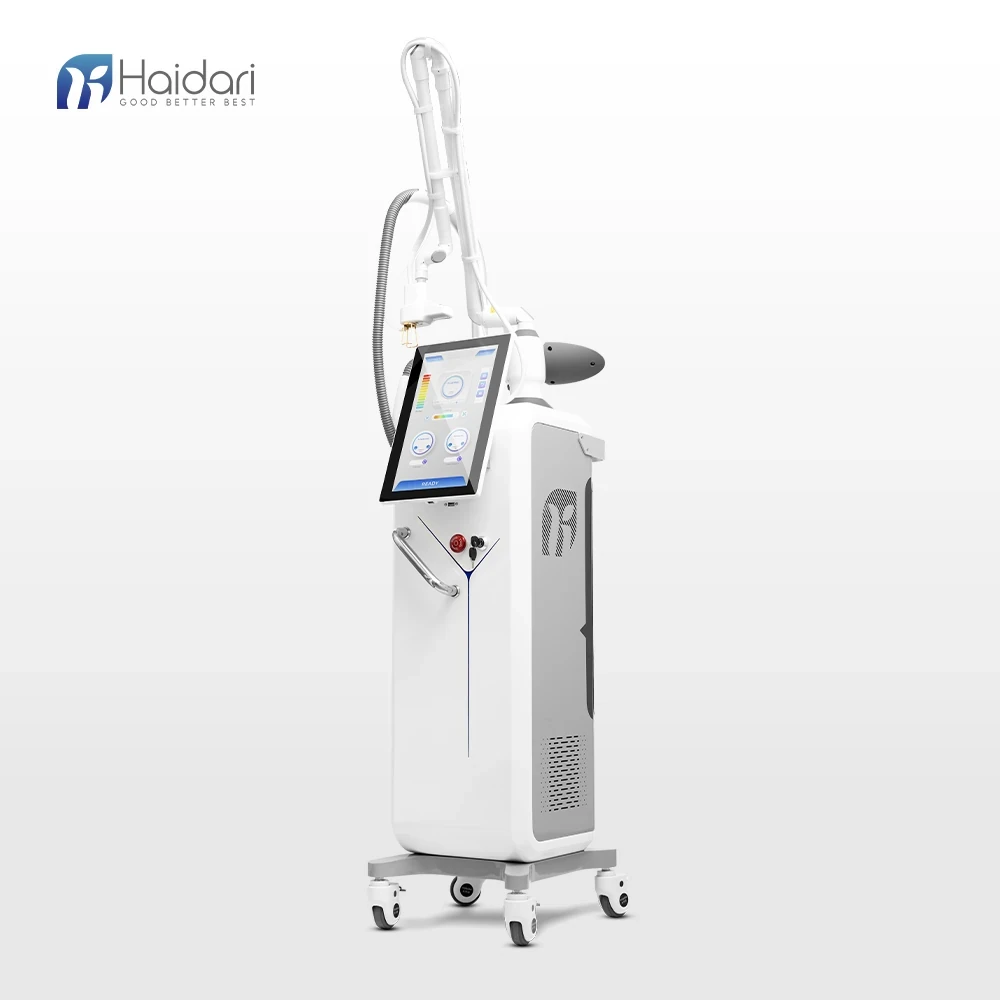
To meet the demand for more versatile aesthetic solutions, our 10600nm CO₂ + 1550nm 2-in-1 combined beam laser system integrates two complementary wavelengths into one platform.
The system combines 10600nm CO₂ fractional laser technology with 1550nm non-ablative laser technology, allowing clinics to provide different treatment approaches without purchasing separate devices.
Integrated 10600nm CO₂ and 1550nm Wavelengths for Flexible Treatments
The system uses 2-in-1 combined beam technology, integrating both wavelengths into a single laser platform.
The 10600nm CO₂ wavelength provides fractional resurfacing, while the 1550nm wavelength delivers non-ablative thermal stimulation to deeper skin layers.
With adjustable energy ratios, practitioners can select different treatment modes, including CO₂-only, 1550nm-only, or combined wavelength treatments according to patient requirements.
High-Performance Configuration for Efficient Clinic Operations
The system includes a 70W 10600nm CO₂ laser module and a 15W 1550nm laser module.
It is equipped with a 15×22mm galvanometer scanner and a 240W scanning motor to support efficient treatment coverage and stable scanning performance.
The equipment is designed to support continuous operation for up to 24 hours, helping clinics maximize daily equipment utilization.
Quality Components and In-House Manufacturing Expertise
The system incorporates a Korean laser arm, German-imported scanning motor, France-imported laser fiber, and Z-shaped CO₂ laser cavity design.
The laser modules are developed and manufactured at our factory. We are the first company in China to achieve 2-in-1 beam combining technology.
The system complies with IEC 60601-1 and ISO 13485 standards, supporting reliable operation for professional aesthetic applications.
How This 2-in-1 Laser Platform Helps Clinics Improve ROI
Reduce Equipment Investment with One Integrated System
Traditional clinics may need separate devices to provide CO₂ and non-ablative treatments. This increases purchasing costs, maintenance requirements, and space usage.
By integrating two wavelengths into one system, this platform provides access to multiple treatment technologies while reducing equipment investment.
The equipment price is approximately 30% lower than comparable multi-device solutions, helping clinics improve cost efficiency.
Expand Treatment Options and Revenue Opportunities
The system supports multiple treatment modes, allowing clinics to design different service packages according to patient needs.
With applications across beauty salons, aesthetic clinics, and dermatology clinics, the platform helps businesses expand treatment offerings while improving equipment utilization.
Faster Equipment Payback Potential
Advanced aesthetic laser treatments are often positioned as premium services, with a single session often costing over $300 in suitable markets.
Depending on patient volume, pricing strategy, and clinic operation, the equipment investment can typically be recovered within approximately two months.
Over the equipment lifespan, the potential return on investment can exceed 1:100 when the system is effectively utilized.
Actual ROI will vary depending on market conditions and business management.
Frequently Asked Questions About CO₂ + 1550nm Laser Systems
Q1: Can one device replace separate CO₂ and non-ablative laser systems?
A: Yes. The 2-in-1 combined beam laser system integrates 10600nm CO₂ and 1550nm wavelengths into one platform, allowing clinics to provide both ablative and non-ablative treatment options without purchasing two separate devices.
Q2: What treatment modes does this laser system support?
A: The system supports CO₂-only mode, 1550nm-only mode, and combined wavelength mode. Practitioners can adjust treatment approaches based on patient requirements.
Q3: What clinics are suitable for this laser system?
A: The system is designed for professional aesthetic applications in beauty salons, aesthetic clinics, and dermatology clinics that require flexible treatment options.
Q4: Do you provide training after purchasing the machine?
A: Yes. We provide video training after customers receive the machine to help operators understand the basic functions and operation procedures.
Q5: Can the machine operate continuously?
A: Yes. The system is designed to support continuous operation for up to 24 hours, helping clinics improve equipment utilization.
Conclusion
The combination of 10600nm CO₂ and 1550nm non-ablative laser technologies gives clinics the option to combine two different treatment approaches in one system.
With 2-in-1 beam combining technology, this laser platform allows beauty salons, aesthetic clinics, and dermatology clinics to access both CO₂ fractional and non-ablative laser functions without investing in two separate systems.
When choosing the best co2 fractional laser machine, clinics should consider not only laser specifications but also system design, component quality, manufacturing capability, and long-term technical support.
Contact our team to learn more about the 10600nm CO₂ + 1550nm 2-in-1 laser system and discuss how this integrated solution can support your clinic’s treatment requirements.