
How to Choose a Professional Pico Laser Machine: A B2B Buyer’s Guide for Aesthetic Clinics
Introduction
With the increasing demand for tattoo removal, plasma treatment and skin regeneration, the global beauty laser market continues to expand. According to a report by Grand View Research, the global tattoo removal market is estimated to be USD 4.5 billion in 2023, and it is estimated that the compound annual growth rate (CAGR) will be 5.4% from 2024 to 2030 (Grand View Research 2024). As more and more patients seek effective solutions for unwanted ink and pigment lesions, clinics are faced with a key procurement challenge: to distinguish genuine picosecond laser systems from pseudo-picosecond devices and sub-nanosecond equipment full of misleading specifications.
For a B2B buyer, choosing a professional picosecond laser is not just about comparing price. It requires a clear understanding of laser physics, component sources, clinical results, and total cost of ownership. This guide provides a practical roadmap based on evidence to help clinical decision-makers evaluate equipment suitable for their practice, including key technical parameters, country of origin, return on investment, and direct cooperation with an experienced pico laser machine manufacturer.
1. Core Physics: Photothermal vs. Photoacoustic Breakdown
Traditional Q-switched nanosecond lasers rely on the photothermal effect: pigment particles absorb light energy, heat up, and are crushed by thermal expansion. Although it is effective for some dark inks, this thermal mechanism usually damages surrounding tissue, leading to blisters, post-inflammatory hyperpigmentation (PIH) and scars, especially in darker skin types.
Picosecond lasers work by a fundamentally different mechanism-photoacoustic splitting. Picosecond lasers emit pulses lasting trillionths of a second, and the energy is transmitted so fast that pigment particles are fragmented primarily by photoacoustic shockwaves rather than heat. This produces finer pigment fragments, which can be removed more effectively by the lymphatic system, while protecting adjacent skin tissues.
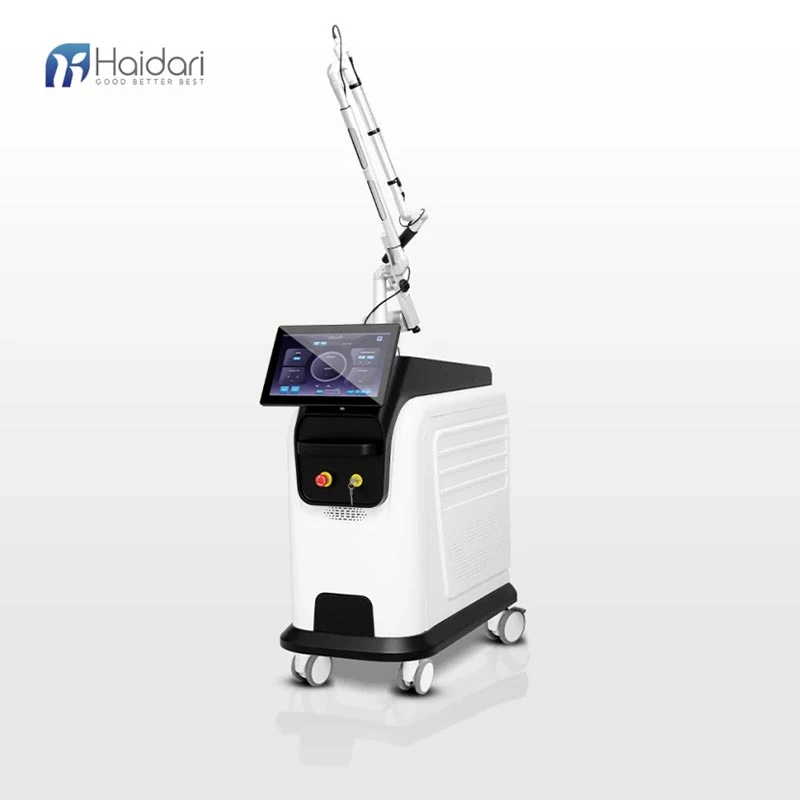
The real picosecond platform is defined by physics, not marketing labels. For example, devices that can really provide a pulse width of 300 picoseconds, such as the PicoHai system, can produce photoacoustic dominant effect. The peak power is 2.0 GW, and the tolerance of energy stability is less than 3%. This system can minimize the risk of thermal damage even in repeated sessions. Clinics that switched from pseudo-picosecond devices below 450 ps to the verified 300 ps platform reported that the removal speed of color tattoos was significantly faster and the downtime of patients was less. For buyers, the key point is simple: always verify the real pulse duration and peak power output recorded in the manufacturer’s technical specifications, not just the brand name.
2. Technology Comparison: Real Picosecond vs. Q-Switched Nd:YAG
Different clinical models require different technical levels. A high-volume aesthetic centre specialising in multicolour tattoo removal and skin revitalization will benefit most from a true picosecond system. A start-up company that mainly focuses on black ink or services with a limited budget might still find excellent value in a high-quality Q-Switch Nd:YAG laser tattoo removal machine. The following table makes an objective comparison between the two technologies.
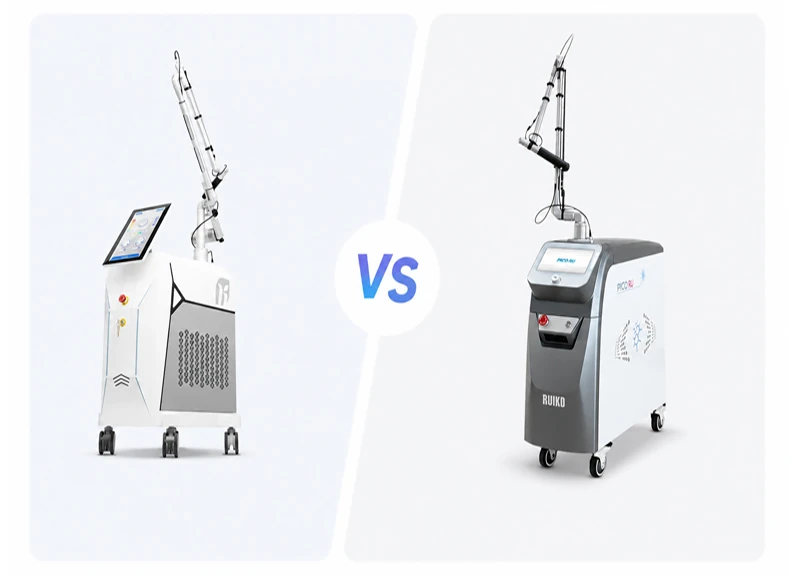
| Parameter | Real Picosecond Laser (e.g., PicoHai / PICO RU) | Q-Switched Nd:YAG Laser (e.g., RE BEAN) |
| Pulse Width | 300 – 350 ps (ultra-short) | 5 – 10 ns (nanosecond) |
| Primary Mechanism | Photoacoustic (acoustic shockwaves) | Photothermal (thermal heating) |
| Tattoo Colours Treatable | All colours (with multi-wavelength handpieces) | Primarily dark pigments (black, dark blue) |
| Typical Treatment Sessions | 3–5 sessions | 8–12 sessions |
| Downtime & Risk | Minimal; significantly lower PIH risk | Moderate; higher risk of scarring/PIH |
| Ideal Clinic Profile | Premium medical spas, high-volume dermatology clinics | Entry-level clinics, budget-conscious spas |
From B2B’s point of view, there is no universal “better” -only the correct method suitable for the clinical combination. RE BEAN is a well-designed Q-switched Nd: YAG platform, which uses a flat-topped beam profile and is still a cost-effective and clinical choice for removing basic dark tattoos. However, if the long-term plan includes extending to color ink removal, chloasma and collagen remodeling, investing in a real picosecond platform is a decision that can stand the test in the future.
3. The Impact of Device Origin: Why Korean Platforms are Highly Coveted
In medical aesthetics, the source of laser equipment is usually associated with optical accuracy, reliability of the cooling system and clinical compliance. Picosecond lasers designed by South Korea have won a high reputation, because manufacturers in this area usually implement strict quality control over optical components, integrate stable resonator designs and meet international safety standards.
PICO RU system is an example that uses technology imported from South Korea’s Ruikd company. It provides a peak power of 2.1 GW and is equipped with three special handpieces: a zoom handpiece for focal point therapy, an MLA (microlens array) handpiece for inducing laser-induced optical breakdown (LIOB) to stimulate dermal collagen regeneration without ablating the epidermis, and a collimating handpiece for large-area color matching. This combination enables a platform to cover pigmentation removal, tattoo removal, skin regeneration and carbon stripping procedures. For a clinic owner who evaluate Korean engineering platform, the decision usually comes down to ensuring the recorded clinical performance and component life, both of which reduce long-term service interruptions.
4. Buying Factors: Evaluating the Total Pico Laser Price and ROI
When comparing pico laser price quotations, experienced buyers are not only concerned about the upfront hardware cost. Correct financial analysis must consider the total Cost of ownership (TCO), including:
- Laser generator source and consumables: Imported optical components—such as American laser rods, Japanese KTP crystals, and UK-made flashlamps—may raise the initial purchase cost but significantly extend service intervals and energy stability.
- Handpiece lifespan and replacement fees: Some manufacturers offer low headline prices but charge heavily for consumable handpieces. Verify warranty coverage on MLA and zoom handpieces.
- Wavelength configurations: A dual-wavelength base model (1064 nm / 532 nm) covers most indications, but optional 585 nm and 650 nm handpieces, available on platforms like PicoHai, expand the clinical menu.
A conservative ROI model assumes that a picosecond treatment costs 300-500 dollars. A clinic can generate monthly income of about $ 27,000 (calculated at $ 300 each time) only by treating three times a day. The cost of equipment is about 30,000– to 40,000 dollars, and the payback period of capital is usually within two months. During the life of typical equipment, the return on investment can exceed 1: 100, which is the figure reported by Haidari’s clinic partners. Therefore, the “best” financial decision is not the cheapest headline number, but a decision that combines reliable performance, fast return and minimum hidden costs.
5. Why Partnering Directly with a Pico Laser Machine Manufacturer Matters
It is usually easier and more cost-effective to purchase the best pico laser machine for your clinic when you cooperate directly with the original equipment manufacturer, rather than through an intermediary dealer.
Customisation (OEM/ODM)
A direct cooperative relationship has released the ability to customize the house design, user interface language and brand. For example, Haidari Beauty provides comprehensive OEM/ODM services, allowing regional distributors and large clinic networks to sell the equipment under their own brand names, while retaining the core optical module manufactured in-house.
Direct Technical Support
A manufacturer with an integrated R&D and production line, such as Haidarei Technology (Beijing) Co., Ltd., which started operation in 2014, can provide a two-year machine warranty, lifetime maintenance support and video-based operation training. This eliminates the common delays and price increases when relying on third-party service agents.
Supply Chain Stability
Purchasing directly from the factory floor eliminates multi-tier distributor margins, often reducing the acquisition cost by approximately 30% compared to intermediary-supplied devices with equivalent specifications. Coupled with consistent supply of parts, this ensures that the total cost of ownership is reduced throughout the life of the machine.
6. 5 Steps to Make Your Final Purchase Decision
Use this checklist when evaluating any picosecond laser proposal:
1. Confirm peak power and true pulse width – Does the device deliver a verified 300–350 ps pulse, and what is the measured peak power?
2. Analyse patient demographics – Will your case mix require multi-wavelength handpieces for warm-coloured inks and skin rejuvenation?
3. Select the right device tier – Choose a premium Korean-engineered platform like PICO RU for high-end dermatology practices, or a self-developed high-value platform like PicoHai for custom-branding and cost efficiency.
4. Verify post-sales support – Is there a minimum two-year warranty, consumable coverage, and structured clinical training?
5. Compare quotes and certifications – Request factory-direct price sheets alongside CE and ISO 13485 certificates. Never compromise on compliance.
Conclusion
In summary, the decision to invest in a picosecond laser system should be guided by verified technical specifications, an honest assessment of clinical needs, and a thorough total-cost analysis. Whether a clinic opts for a premium korean pico laser or a versatile self-developed model, partnering with an experienced original equipment manufacturer ensures reliable after-sales support and supply chain transparency. By prioritising documented performance over marketing claims, aesthetic clinics can confidently build a treatment offering that delivers measurable patient outcomes and sustainable practice growth.
Frequently Asked Questions (FAQ)
Q1: Do you provide training after purchase?
A1: Yes, we will provide comprehensive video training immediately upon receiving the machine. Remote clinical application guidance is also available for partner clinics.
Q2: What is the warranty period?
A2: We provide a 2-year warranty on the entire machine, with lifetime maintenance support and readily available spare parts.
Q3: Can this equipment treat melasma safely on darker skin types?
A3: When used by trained professionals under appropriate settings, picosecond lasers with ultra-short pulse duration can treat chloasma. Compared with a nanosecond laser, the risk of PIH is lower because it is mainly a photoacoustic mechanism rather than a thermal mechanism.