
Unlock the Secret of Skin Resurfacing: Haifrax Pro 10600nm+1550nm
1. Introduction: The Evolution of Skin Resurfacing Technologies
Every skin resurfacing treatment involves a balance between visible results and recovery time. Traditional CO₂ lasers deliver impressive improvements, but patients often have to accept longer downtime. Non-ablative systems shorten recovery, although multiple sessions are usually required. Aggressive, fully ablative 10600nm treatments can deliver a striking single-session transformation, removing photodamaged epidermis and tightening collagen fibres. The downside is the longer healing period a longer healing period, persistent erythema, and a significant risk of post-inflammatory hyperpigmentation, particularly for individuals with olive to deeply pigmented skin.
The gold-standard tool for such deep resurfacing is a medical fractional CO2 laser. This device creates microscopic columns of vaporised tissue, triggering a powerful wound-healing cascade that smooths wrinkles and softens atrophic scars. Yet even in fractional mode, the epidermal disruption inherent to the 10600nm wavelength means that patients often require seven to ten days before makeup can comfortably conceal the residual redness [Source: American Society for Laser Medicine and Surgery].
On the other side of the spectrum sits non-ablative technology based on an erbium-glass laser. These systems deliver controlled thermal injury to the dermis while sparing the overlying stratum corneum, which dramatically shortens visible recovery. The limitation has traditionally been the number of sessions required to approach the collagen remodelling achieved by a single ablative procedure. Many clinicians therefore face a dilemma: prioritise immediate dramatic results or prioritise safety and patient convenience.
Modern aesthetic platforms are now bridging this gap by integrating both modalities in one workstation. By combining both wavelengths, clinicians can protect more of the skin surface while still stimulating deeper tissue repair. Haidari Beauty’s response to this clinical demand, the Haifrax Pro 10600nm+1550nm, is engineered precisely for this dual-wavelength approach, allowing practitioners to tailor ablation and coagulation with a degree of control that standalone devices rarely offer.
2. The Science Behind Haifrax Pro: How 10600nm and 1550nm Synergize
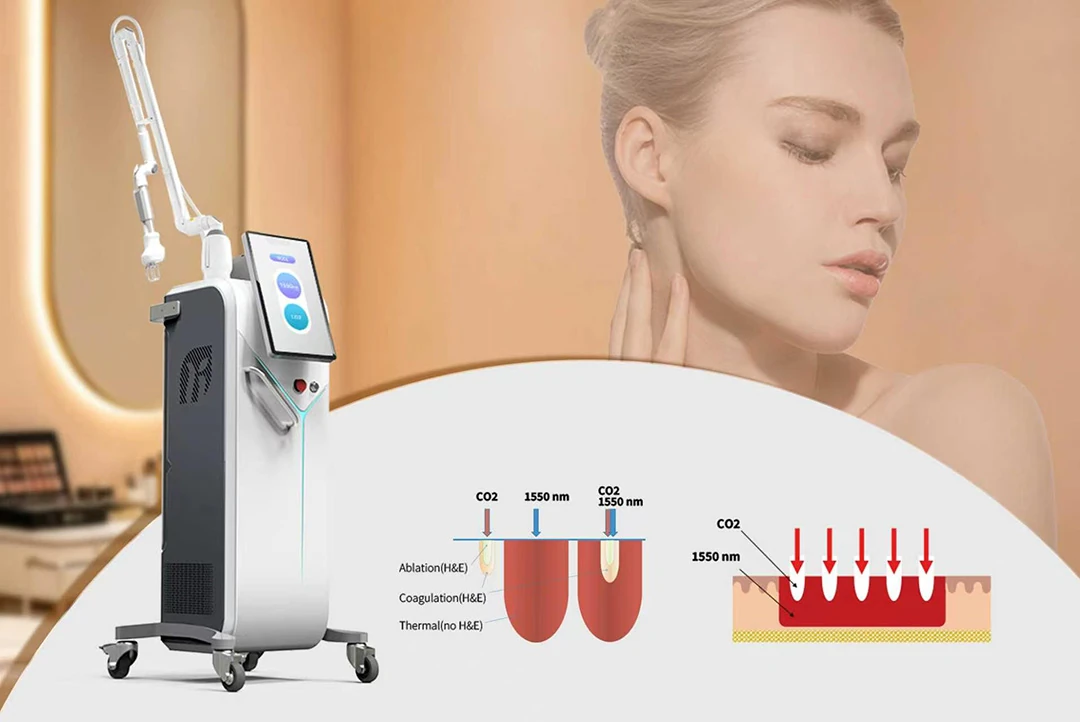
The 10600nm carbon-dioxide wavelength exhibits an exceptionally high absorption coefficient in tissue water. When delivered through a fractional handpiece, each micro-beam instantly heats and vaporises a narrow channel of epidermis and superficial dermis. This creates a clean ablation zone surrounded by a thin rim of coagulated tissue, which together launch a repair process that replaces damaged collagen with newly organised fibres over the subsequent three to six months. The Haifrax Pro sources its CO₂ energy from a US-built Coherent radio-frequency metal tube housed in a proprietary Z-shape cavity, a design that helps maintain stable peak power and consistent micro-beam geometry throughout the laser’s service life.
Deeper dermal heating, however, is where the non-ablative channel proves essential. The 1550nm laser wavelength penetrates beyond the epidermis with minimal surface absorption, targeting water in the papillary and upper reticular dermis at depths often exceeding 700 µm [1]. This creates neat columns of thermal denaturation that stimulate fibroblast activity and neocollagenesis while leaving the skin’s barrier function largely intact. In the Haifrax Pro, the 1550nm module is built around a France-imported gain fibre and an in-house resonator, delivering peak powers that are substantially higher than the 10 W modules commonly found in entry-level Korean platforms (based on publicly available manufacturer specifications, 2025). In practice, this allows a denser, deeper thermal footprint in a single pass, which may translate to fewer sessions for the patient.
When these two wavelengths are fired in a mixed sequential protocol, the clinical interaction is complementary rather than merely additive. The ablative channels created by the CO₂ component allow the 1550nm energy to penetrate slightly more efficiently through the already opened micro-zones, while the broad dermal heating from the erbium-glass pulse helps consolidate the tissue tightening initiated by the ablative pass.
3. Key Clinical Benefits of Haifrax Pro for Dermatology Practices
The flexibility built into a Fractional CO2+erbium–glass laser platform proves especially valuable in a multi-ethnic patient base. With the Haifrax Pro, the practitioner can select a predominantly non-ablative 1550nm pattern for darker skin types that are prone to pigmentary changes, reserving low-density CO₂ micro-beams only for focal deeper scars. A lighter phototype seeking maximum wrinkle reduction, on the other hand, can safely receive a denser ablative grid followed by a moderate 1550nm boost. This range of settings is managed through a German-made galvo scanner whose high-power motor (rated at 240 W) supports a variety of scanning patterns, including a snail-mode that deliberately slows the scan sequence to reduce thermal overlap.
One of the biggest reasons clinics choose dual-wavelength systems is the shorter recovery period. Because a significant portion of the dermal rejuvenation comes from the non-ablative erbium-glass channel, clinicians often feel comfortable scaling back the CO₂ pulse energy or beam density without compromising the overall result. The preserved epidermal bridges promote faster re-epithelialisation, and many Haifrax Pro users observe that post-treatment oedema and crusting resolve roughly 20–30% sooner than with their previous single-wavelength CO₂ procedures (based on internal clinic feedback collected by Haidari Beauty, 2024–2025). This swifter recovery is a critical factor in patient acceptance and word-of-mouth referrals.
The platform can also be used for procedures beyond facial resurfacing, helping clinics improve equipment utilization and ROI. In addition to the fractional scanning handpieces, the platform can be configured with a continuous-wave surgical cutting tool for minor lesion excisions and a dedicated gynecological probe for vaginal tightening treatments. A busy dermatology or aesthetic clinic can therefore consolidate several capital purchases into one 24-hour-duty-cycle system that accommodates a wider treatment menu.
One clinic using this protocol reported in a diverse metropolitan area. Its previous fractional CO₂-only device produced noticeable improvement in acne scars but regularly left patients with Fitzpatrick skin types III–IV dealing with two to three months of post-treatment hyperpigmentation, requiring additional topical management and eroding patient confidence. After integrating the Haifrax Pro, the lead clinician adopted a protocol that relies on the 1550nm mode for 70% of the total energy delivery and adds a sparse CO₂ pattern only over the deepest atrophic scars. Twelve months later, patient satisfaction scores for scar correction rose measurably, and the incidence of transient PIH dropped below 4% (clinic audit data, 2025). With treatment fees exceeding $500 per combined session, the capital cost of the machine was fully recovered within eight weeks, and the long-term return on investment over the system’s lifetime is projected to surpass 1:100.
4. Technical Specifications Comparison
The table below places the Haifrax Pro’s key engineering specifications alongside those of conventional fractional platforms. The performance data are drawn from the manufacturer’s technical documentation and have been verified through testing compliant with IEC 60601-1 safety and performance standards.
| Specification | Haifrax Pro 10600nm+1550nm | Typical Entry-Level Fractional Systems |
| CO₂ laser source | 10600nm, 70 W or 100 W; US Coherent RF metal tube, Z-shape resonator | 10600nm, 30–60 W; DC glass tube |
| 1550nm erbium-glass source | Up to 30 W peak; France-imported fibre, factory-built resonator | 5–10 W peak |
| Galvo scanner motor power | 240 W (German-origin, patented) | 60–120 W |
| Microthermal Treatment Zone (MTZ) | Adjustable 80–200 µm | Typically 100–250 µm |
| Scan patterns | Multiple geometries including Snail slow-scan | Circle, square, line |
| Articulated arm | 7-joint, 360° torsion-spring balanced | 4-joint rigid or semi-rigid |
| Dual-wavelength mixed shot | Yes; 10600nm and 1550nm can be fired together | Not available |
| Continuous operation rating | Designed for 24-hour duty cycles | Typically 8–12 hours |
| Certifications | ISO 13485, IEC 60601-1, CE (MDD/MDR), EMC | CE (LVD) or limited |
5. Why Choose Haidari Beauty for Your Wholesale Procurement?
When a distributor or a large clinic group evaluates a wholesale fractional CO2 laser machine, the decision rarely hinges on power specifications alone. Supply-chain reliability, regulatory compliance, and post-sale engineering support are equally decisive. Haidari Beauty has spent over 20 years building a research-and-manufacturing infrastructure that includes more than 50 dedicated engineers and an annual production capacity of over 6,000 units. This scale allows the company to maintain consistent component quality while offering flexible OEM/ODM services with low minimum order quantities.
Manufacturing consistency is reinforced by a quality management system certified to ISO 13485, and every Haifrax Pro is tested to meet the electrical safety requirements of IEC 60601-1 as well as the comprehensive demands of the European Medical Device Regulation and EMC directives. Such a certification footprint simplifies the import and registration process for clinics in regulated markets, giving buyers confidence that they are placing a clinically appropriate system in their facility.
The long-term economics are supported by a standard two-year warranty that can optionally be extended to five years on the core laser modules. Immediately after delivery, each customer receives a structured video training library covering treatment protocols, handpiece maintenance, and user-interface navigation. Remote technical support is available to troubleshoot issues and guide calibration, reducing the need for costly on-site service visits. These measures help clinics keep the medical fractional CO2 laser in continuous clinical rotation, maximising patient throughput and revenue.
For a procurement specialist looking to partner with a manufacturer that controls its own resonator and scanner IP, Haidari Beauty offers a transparent path from factory floor to treatment room. The combination of American RF tube reliability, German scanner precision, and self-developed 1550nm technology ensures that the Haifrax Pro can serve as a dependable workhorse in a busy aesthetic practice.
6. Conclusion
Combining ablative CO₂ and non-ablative 1550nm technology gives clinicians more flexibility when treating different skin concerns. Rather than asking patients to choose between dramatic results and minimal downtime, a thoughtfully designed dual-wavelength system lets the clinician tailor energy delivery to each person’s phototype and lesion profile. The Haifrax Pro has been built to serve precisely this purpose, using robust component sourcing and a modular architecture that can grow with a clinic’s service offerings.
To explore how the Haifrax Pro might fit into your treatment portfolio or distribution network, we welcome you to visit the official Haidari Beauty website. Our clinical product team can supply detailed technical white papers, arrange a virtual demonstration, or prepare a personalised quotation based on your intended clinical applications and order volume. We look forward to supporting your practice with technology that is backed by documented engineering and transparent performance data.
FAQ
Q1: Do you include training and warranty coverage with the machine?
A: Yes. Immediately after shipment, we provide a comprehensive set of video tutorials that guide you through system setup, treatment parameter selection, and routine maintenance. The standard warranty lasts two years, and an extended program covering the laser tubes and scanner can be requested for up to five years.
Q2: Can a non–ablative 1550nm device be used safely on darker skin types?
A: Because a 1550nm laser preserves the epidermal barrier, it is widely considered a safer option for Fitzpatrick skin types IV to VI. Clinical studies and guidelines note a substantially lower incidence of post-inflammatory hyperpigmentation compared with fully ablative lasers, provided appropriate energy levels and spot densities are used. Performing a small test spot and observing the skin’s response over several days remains a prudent step before full treatment.
Q3: What is the difference between a traditional CO₂ fractional system and a dual–wavelength resurfacing platform?
A: A traditional CO₂ fractional system creates purely ablative channels, yielding significant tissue contraction but often requiring a longer healing period. A dual-wavelength platform that combines fractional CO₂ and erbium-glass adds a second non-ablative wavelength that heats the dermis without removing the epidermis. This combined approach can deliver comparable collagen remodelling with more preserved surface integrity, making it particularly useful for patients who wish to limit social downtime and reduce pigmentation risks.