
Maximizing MedSpa ROI: Why Triple Wavelength Diode Laser Hair Removal Machines Dominate the Market
The global aesthetics industry is evolving rapidly. For medical spas and dermatology clinics, delivering safe, consistent results while maintaining profitability has become increasingly important. Traditional intense pulsed light (IPL) systems, once widely used for hair removal, are now showing limitations in treatment efficiency, patient comfort, and overall performance. As a result, the diode laser hair removal machine has become the preferred solution for many professional clinics.
This article explains why more clinics are making the switch, using practical clinical evidence and commercial considerations to support informed purchasing decisions.
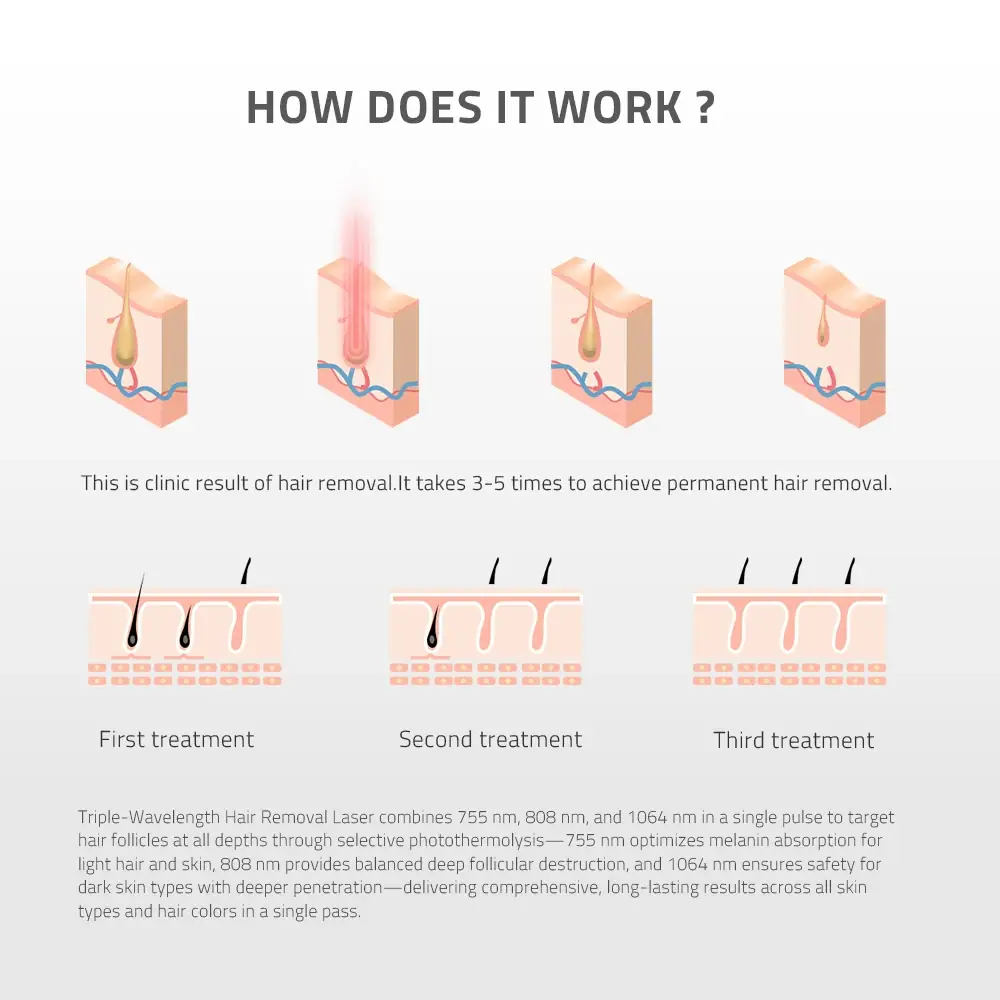
Unlike IPL, which emits a broad spectrum of light and only partially targets melanin, diode lasers deliver energy at specific wavelengths for greater precision. Modern systems typically combine 755 nm, 808 nm, and 1064 nm wavelengths, allowing them to treat follicles at different depths and across different hair types. The 755 nm wavelength is effective for fine, lighter hair, 808 nm provides balanced performance for most treatments, and 1064 nm offers safer treatment for darker skin tones up to Fitzpatrick Type VI. By targeting hair follicles more accurately, multi-wavelength diode technology delivers faster, more consistent results while reducing the risk of burns and post-inflammatory hyperpigmentation.
Side–by–side comparison of IPL and advanced diode technology
| Parameter / Feature | Traditional IPL Equipment | Triple Wavelength Diode Laser |
| Energy target | Broad spectrum, low selectivity | Highly selective melanin absorption at three depths |
| Coarse & dark hair reduction | Approx. 60% clearance after 6–8 sessions | Up to 3× faster treatment for long-term reduction |
| Skin type adaptability | Limited; high risk on darker skin | Clinically safe for all skin tones (I–VI) |
| Typical session time (full legs) | 40–60 minutes | 15–20 minutes |
| Cooling system | Often basic contact cooling or gel | Integrated sapphire contact + TEC + air cooling |
Inside the Tech: Key Parameters of a Professional Platform
When assessing an equipment investment, clinics must look beyond wavelength and focus on three critical hardware specifications that separate premium systems from budget alternatives.
Power and energy density
A high-powered source drastically reduces treatment time. For example, a platform with an 1800 W laser source can deliver up to 120 J/cm² energy density and operate at a repetition rate of 10 Hz. Compared with typical 600 W single-wavelength or 1550 nm devices, this represents a 2–3× increase in output. The ability to fire mixed wavelengths simultaneously further compresses session length without compromising safety, directly raising the number of patients a clinic can serve per day.
Advanced cooling and 24/7 operation
Thermal management is critical for both patient safety and device longevity. The system relies on a Japan-imported 500 W TEC (thermoelectric cooler) – substantially above the 300 W industry average – paired with sapphire contact cooling and forced-air cooling. Skin temperature is kept within a safe, comfortable range throughout the session. The robust cooling architecture also supports continuous operation; the machine can run 24 hours a day, making it suitable for high-volume clinics with packed appointment schedules.
Patented replaceable spot tips
One often overlooked factor in laser efficiency is the optical delivery system. A core patent held by Haidari Beauty covers a family of four interchangeable spot sizes. These handpieces are engineered to minimize energy loss between the diode bars and the skin surface – a common weakness in fixed-head designs. As an 808nm diode laser machine supplier with in-house manufacturing, Haidari Beauty has integrated this technology directly into its design. The replaceable tips allow clinicians to use large spot sizes for back or leg treatments and small spots for precise upper lip or bikini work, all while maintaining faster cooling transmission and reducing the total cost of ownership.
Compliance and Certifications
Medical aesthetic devices are subject to rigorous regulatory oversight. The equipment discussed here holds certifications that are independently audited, confirming compliance with essential safety and performance standards:
- CE 2014/35/EU (Low Voltage Directive)
- IEC 60601-1 (Medical electrical equipment safety)
- ISO 13485 (Quality management system for medical devices)
For a clinic owner, such documentation simplifies insurance, liability, and regulatory compliance, and it signals that the manufacturer follows internationally recognized quality processes.
Financial Model: ROI and Payback Period Calculation
Once daily treatment throughput is taken into account, the economic case for high-end semiconductor laser platforms becomes particularly clear. In mature markets, the average price for a single laser hair removal session is generally over US$250. Even using a relatively conservative estimate—at US$200 per session and 10 clients per day—daily revenue can reach US$2,000. Based on an average of 25 working days per month, the service revenue generated directly by this machine can reach US$50,000 per month.
Most aesthetic clinics that upgrade from IPL to a high-speed laser hair removal machine for business report that the equipment pays for itself within two months. After the initial payback, ongoing costs consist primarily of consumables and periodic maintenance. Over the entire service life of the equipment, its return on investment is projected to exceed a ratio of 1:100. This figure reflects not only direct revenue from treatment, but also encompasses the increased customer retention and referral rates, as well as the overall value derived from being able to safely treat a wider patient population whilst avoiding side effects.
Real–World Case Study: IPL to Diode Laser Upgrade in Germany
A beauty salon in Germany had relied on IPL for hair removal for several years, but three specific pain points were undermining its growth. First, IPL’s low energy density meant the removal rate for dark, coarse hair was only around 60%. Clients typically needed six to eight sessions, and complaints were frequent. Second, without a precise cooling system, two skin burn complaints had been filed in the previous year by clients with darker complexions. Third, each IPL session took 40–60 minutes, limiting the salon to eight clients per day and capping revenue.
The salon switched to a triple-wavelength diode laser system sourced from Haidari Beauty. The device features an 808 nm diode bar with two additional wavelengths, a 14-inch touch screen with a German-language interface, and the triple-cooling system (sapphire contact + 500 W TEC + air). After a week of remote video training, the staff integrated the new system into their daily workflow.
Within just three months, the duration of each consultation was optimised to between 15 and 20 minutes, and the daily number of clients served jumped from 8 to 18. This improvement in efficiency has translated into a significant leap in the customer experience: customer satisfaction scores have risen from 4.1 stars to 4.8 stars, whilst the referral rate from existing customers has increased by a substantial 40 per cent. The two devices completed over 540 treatments in three months. The full capital investment was recovered in just two months. This beauty salon has demonstrated its firm belief in this technology through repeated investments—it has just acquired two more machines for its new branch. According to data from the American Society of Plastic Surgeons (ASPS), laser hair removal remains one of the most commonly performed minimally invasive cosmetic procedures in the United States, with millions of procedures carried out each year.
Conclusion: Partnering with a Verified Supplier
The evidence is clear: upgrading to a triple wavelength diode laser platform delivers clinical versatility, improves patient safety, and dramatically shortens the payback period. For clinic owners evaluating a laser hair removal device for their practice, the key differentiators lie in output power, patented handpiece design, cooling capacity, and international certifications. The right equipment decision transforms operational constraints into revenue growth.
Haidari Beauty, with over 20 years of R&D and manufacturing experience, is a trusted global supplier of 808 nm diode laser systems. The company’s portfolio includes CE-, IEC-, and ISO-certified platforms with patented replaceable tips, high-power TEC cooling, and OEM/ODM customization options. To explore specifications, training support, and transparent pricing details, visit.
Frequently Asked Questions
Q1: What is the average professional laser hair removal machine price?
A1: The professional laser hair removal machine price varies significantly based on output power, wavelength technology, cooling architecture, and regulatory certifications. Premium diode platforms are typically priced to offer a rapid payback, often within two months, thanks to their high daily client throughput and minimal consumable costs.
Q2: Do you provide technical training and warranty for the equipment?
A2: Yes. Haidari Beauty supplies detailed operating manuals, remote video training immediately after delivery, a two-year warranty, and 24-hour online technical support to ensure staff competence from day one.
Q3: Can this diode laser machine operate continuously in a busy clinic?
A3: Absolutely. The 500 W Japan-imported TEC, sapphire contact cooling, and forced-air system work together to maintain safe skin temperatures and protect internal components, supporting 24/7 continuous operation without overheating.