
Pico Laser vs. Q-Switched Nd:YAG Laser: Which Tattoo Removal Machine is the Best Investment for Your Clinic?
Introduction: The Growing Demand for Advanced Tattoo & Pigment Removal
Tattoo removal is no longer a niche treatment offered by a handful of specialized clinics. Today, it has become a routine service in dermatology practices, aesthetic clinics, and medical spas worldwide. Alongside tattoo removal, demand is also growing for treatments targeting melasma, sun spots, post-inflammatory hyperpigmentation, and other pigment-related concerns.
As patient expectations continue to rise, clinic owners are under increasing pressure to deliver faster results, shorter recovery times, and safer treatments across a wider range of skin types. This has led many buyers to compare two of the most widely used pigment-removal technologies: picosecond lasers and Q-switched Nd lasers.
Both technologies have proven clinical value, but they operate differently and serve different business needs. Understanding those differences is essential before making a purchasing decision. In this guide, we’ll compare their treatment mechanisms, clinical applications, operating costs, and return on investment to help determine which platform is the better fit for your clinic.
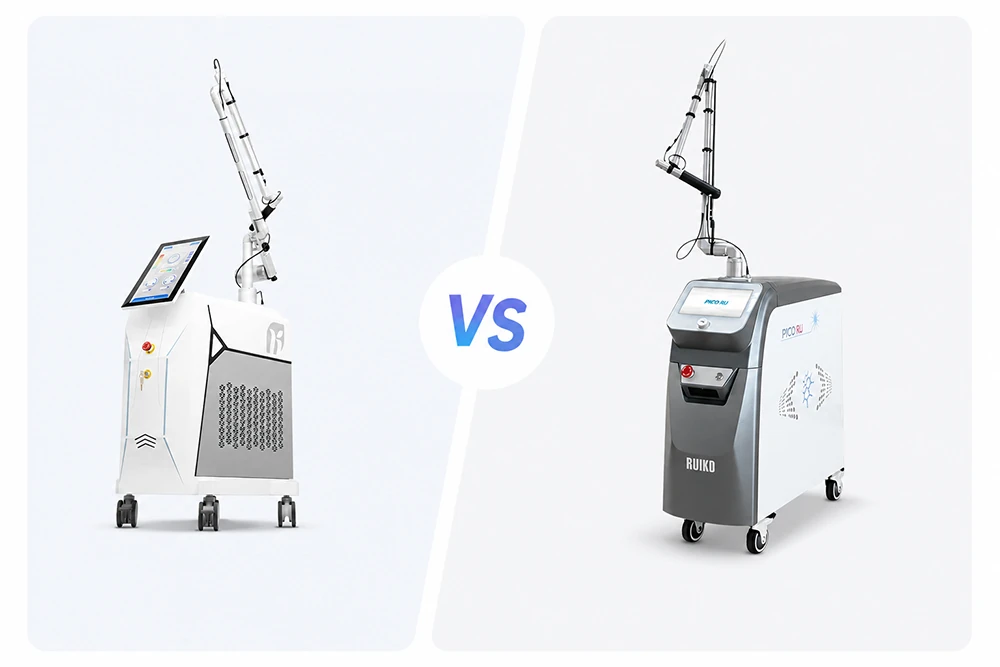
Core Physics: Photothermal Action vs. Photoacoustic Breakdown
To appreciate the differences between nanosecond and picosecond lasers, one must look at how laser energy interacts with dermal pigment. All laser pigment removal relies on the principle of selective photothermolysis—targeting a specific chromophore (ink or melanin) with a wavelength that it absorbs, while sparing the surrounding tissue. However, the speed at which this energy is delivered changes the physical mechanism of destruction entirely.
The Classic Nanosecond Standard: How a q switched nd yag laser Works
For more than three decades, traditional q switched nd:yag lasers have been the industry standard for pigment removal. This technology operates at pulse durations in the nanosecond range (typically 5 to 10 nanoseconds), generating high-energy pulses whose duration is comparable to or slightly shorter than the thermal relaxation time of tattoo ink particles.
When a laser pulse strikes pigment, the pigment particles absorb the light energy and convert it into heat, causing a sharp rise in temperature, which in turn causes the particles to expand and shatter into smaller fragments. Because nanosecond lasers have a relatively long pulse duration (compared to picosecond technology), their mechanism of action relies heavily on the photothermal effect—that is, heat is the primary driving force behind pigment destruction. Although this photothermal effect is highly effective, the generated heat can sometimes spread to the surrounding dermis. Therefore, treatment parameters must be carefully controlled to avoid side effects such as epidermal damage, blistering, or hyperpigmentation—particular caution is required for patients with darker skin tones.
The Picosecond Revolution: Shattering Melanosomes and Ink with a pico second laser
In contrast, the development of modern picosecond lasers represents a breakthrough in the approach to pigment removal. Through shrinking the pulse time to picosecond range (usually 300 to 450 picoseconds), the process of delivering energy will be enhanced up to ten times or even more.
At this ultra-short pulse duration, the laser energy is delivered faster than the thermal expansion time of the pigment. Instead of heating the target, the sudden, extreme concentration of light creates an intense acoustic shockwave. This is known as the photoacoustic effect. The pigment does not have time to heat up; instead, it is mechanically shattered into an ultra-fine, dust-like powder. Because these particles are significantly smaller than the fragments produced by nanosecond lasers, the body’s lymphatic system can phagocytize and clear them much more rapidly. Furthermore, because the thermal footprint is virtually non-existent, the risk of heat-induced side effects is dramatically reduced, making picosecond systems safer for skin types IV through VI.
Clinical Indications: Color Targets and Treatment Versatility
While the physics point to the theoretical superiority of shorter pulse durations, clinical reality is more nuanced. Different ink compositions and skin conditions respond differently to various wavelengths and pulse widths.
Ink Color Clearance: When to Purchase a pico laser tattoo removal machine
Tattoo inks are made of diverse organic and inorganic compounds, each with unique absorption spectra. While traditional black ink absorbs all wavelengths, bright multi-colored tattoos present a major challenge for standard laser systems.
Red, orange, and yellow inks typically respond to green wavelengths such as 532nm. However, blue, green, and purple pigments are notoriously resistant to standard nanosecond treatments, making complete clearance more difficult in complex multi-colored tattoos.
For clinics that frequently treat such cases, investing in a high-performance pico laser tattoo removal machine is often necessary to achieve optimal results. Picosecond platforms operating at specialized wavelengths such as 650nm or 585nm generate intense photoacoustic pressure, which is required to break down these highly reflective pigment compounds. In addition, for difficult dermal pigmentary conditions such as stubborn melasma, the minimal thermal interaction of picosecond pulses helps avoid rebound hyperpigmentation, a side effect more commonly associated with nanosecond laser treatments.
Dark Pigment and Carbon Peels: The Industry Workhorse of a q switch nd yag laser tattoo removal machine
Despite the clinical advantages of picosecond technology for complex cases, it is important to recognize that the vast majority of patients seeking tattoo removal present with standard black or dark blue ink.
For these common pigments, a high-quality q switch nd yag laser tattoo removal machine remains an incredibly effective tool. The 1064nm wavelength delivered in a nanosecond pulse is highly absorbed by black ink, making it a reliable option for clearing standard tattoos. Additionally, nanosecond platforms are the undisputed gold standard for carbon laser peels (often called “carbon facials” or “Hollywood peels”). This highly popular skin rejuvenation treatment relies on a carbon paste applied to the skin, which absorbs the laser energy to exfoliate, tighten pores, and reduce sebum. The mild photothermal heat generated by a nanosecond laser is actually desirable in this application, as it stimulates neocollagenesis in the dermis far more effectively than a pure photoacoustic pulse.
Business Metrics: Evaluating Capital Expenditure, Operating Cost, and Clinical Throughput
Aesthetic devices are clinical tools, but they are also business investments. To maximize your clinic’s profitability, you must balance the initial purchase price against the operational efficiency of the device.
Capital Expenditure and Maintenance of an nd yag q switch laser machine
For newly established medical spa centers, small dermatology clinics, or facilities launching tattoo removal services for the first time, capital expenditure is often a limiting factor.
The low initial purchase cost of nd yag q switch laser machine makes them a highly accessible and low-risk investment option. As highly stable, low-maintenance “workhorse” devices, these systems can quickly generate positive cash flow through high-turnover entry-level treatments.
Compared to picosecond laser systems, the optical components required to generate nanosecond pulses are simpler than the highly specialized pulse compressors used in picosecond technology. As a result, these devices not only have a lower purchase price but also lower maintenance costs. Furthermore, because they contain fewer precision components and are less prone to misalignment during shipping or frequent daily use, nanosecond lasers maintain stable performance and require minimal maintenance.
Higher Session Value and Patient Throughput with Picosecond Platforms
Conversely, for established medical institutions with a large patient volume that are known for their high-end services, the higher upfront investment cost of picosecond lasers may be justified by their superior clinical efficiency.
Because picosecond lasers can break pigment particles down into smaller fragments, patients typically require fewer treatment sessions to achieve complete clearance—generally 4 to 6 sessions, compared to the 8 to 12 sessions typically required by nanosecond lasers. Although this means fewer treatment sessions per patient, a higher premium can be charged for each session. Patients are also generally more willing to pay a higher price per session, knowing that the overall treatment cycle can be cut in half. This faster clearance rate not only improves patient satisfaction and generates more positive word-of-mouth referrals but also frees up treatment room resources to accommodate more new clients, ultimately leading to a better long-term return on investment.
Haidari‘s Solutions: Bridging the Technology Gap with Precision Engineering
At Haidari Technology, we understand that every medical aesthetic practice operates under a unique set of clinical demands and budget constraints. To support global distributors and clinic directors, we have developed a versatile, dual-line product portfolio that spans both advanced Chinese-manufactured platforms and premium imported Korean systems.
Premium Picosecond Platforms: PicoHai (300ps) and PICO RU
For practices seeking to offer the highest standard of photoacoustic pigment clearance, we offer two top-tier picosecond systems:
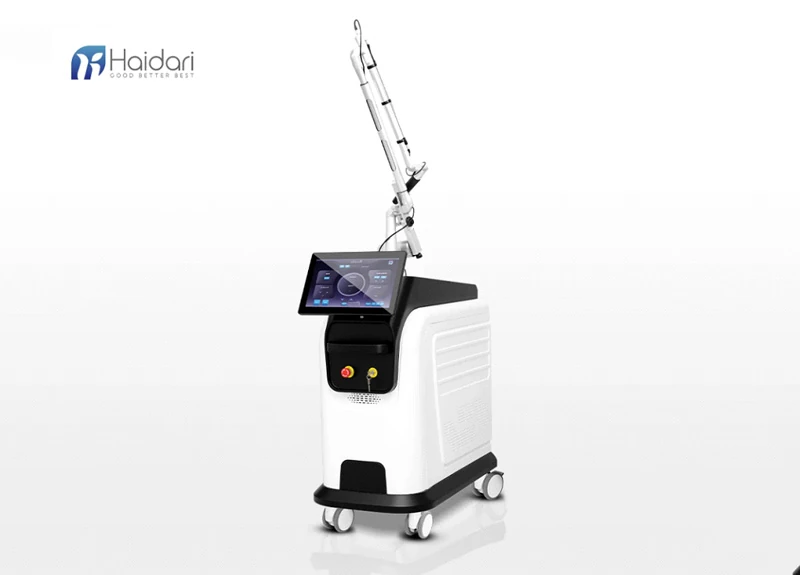
PicoHai 300ps Picosecond Laser Machine (China Line): This system delivers a true 300-picosecond pulse duration with an impressive 1.67 GW peak power. It features up to 600mJ of energy and up to four wavelengths (1064nm, 532nm, and optional 585nm and 650nm) to provide comprehensive coverage for all ink colors and dermal pigment depths.
PICO RU Pico Laser (Korea Line): Imported from South Korea in partnership with Ruikd Technology, the PICO RU is an elite medical-grade platform boasting an astounding 2.1GW peak energy. It is designed for high-stress daily clinical environments, delivering unmatched precision and minimal thermal downtime.
Cost-Effective Q-Switched Workhorses: UltraQ and RE BEAN
For clinics looking for maximum reliability and a rapid return on investment for standard treatments, our Q-switched Nd:YAG portfolio delivers exceptional performance:
UltraQ Nd:YAG Q-Switched Laser Machine (China Line): A highly stable, cost-effective platform featuring 5 distinct treatment modes. It is engineered to deliver consistent nanosecond energy, making it the perfect multi-functional tool for dark tattoo removal and profitable carbon peel facials.
RE BEAN Q-Switched Nd:YAG Laser (Korea Line): This premium Korean-imported system features a flat-top profile (PM Beam Mode) and a proprietary OIPC cooling system. By distributing energy uniformly across the spot area and managing skin temperature, it minimizes epidermal damage and hot spots, providing a safer and more comfortable nanosecond treatment.
Conclusion: Making the Right Strategic Choice for Your Clinic
Ultimately, there is no single “best” technology; the right choice depends on your clinic’s business model and target patient demographic. If your practice primarily treats dark ink tattoos, performs a high volume of carbon facials, and requires a low-maintenance, cost-effective entry point, a nanosecond platform like the UltraQ or RE BEAN is an incredibly sensible and highly profitable choice. However, if you are positioning your clinic as a premium center for dermatological excellence, targeting multi-colored tattoos, and treating sensitive dermal pigmentations like melasma, upgrading to a true picosecond platform like the PicoHai or PICO RU will give you the competitive edge required to lead the market.
To explore customized configuration options, receive technical data sheets, or discuss how our dual-line supply chain can optimize your procurement budget, we invite you to contact Haidari Technology’s clinical engineering team today.