
Laser Hair Removal Machine for Men: What Clinics Need to Know Before Adding the Service
Key Takeaways
- Male hair is coarser, denser and seated deeper than the growth most protocols were written around, so female-menu settings under-treat the follicle and over-heat the skin.
- Demand concentrates on the back, neck and chest, which rewards coverage per hour more than precision on small zones.
- Pulse duration, repetition rate and cooling matter more on coarse hair than a bigger fluence number.
- Skin tone sets the safety ceiling, hair thickness sets the required dose, and a single wavelength forces a compromise between them.
- Spot size and shots per handpiece decide whether a men’s service line pays for itself.
Most aesthetic clinics still present hair removal as a female service. Demand has moved past that. Men now account for close to a third of global demand, and they ask about the areas a razor handles worst: the back, chest and neck.
That looks like easy revenue until the first male clients arrive. Coarse shafts and dense fields behave differently under the same handpiece, so a protocol tuned to finer hair under-treats the follicle and over-heats the skin. What follows covers the mechanics, where demand concentrates, which settings move, and what to insist on in a laser hair removal machine for men.
How Laser Hair Reduction Actually Works
Dark pigment absorbs light, the light becomes heat, and heat delivered to the right structure stops that structure from producing hair. None of it is specific to women. What differs is how much pigment sits in the way, how deep the target lies, and how much heat the skin above it can take.
The target is melanin, and the growth cycle sets the calendar
Melanin in the shaft and the follicle around it is the chromophore, the material that turns light into heat. A pigmented hair in active growth feeds a bulb unusually vulnerable to thermal damage. Interrupt that supply long enough and the follicle stops producing a terminal hair.
Only a fraction of the hair on an area, often a fifth to a third, sits in that phase at any moment. The rest is resting or shedding, and a pulse aimed at it achieves little. Sessions sit four to six weeks apart so dormant follicles can enter growth first. Hair should be shaved, not waxed, because the shaft carries heat down to the bulb.
Why “permanent reduction” is the honest term
Regulators clear these devices for permanent hair reduction, not removal. That means a lasting decrease in regrowth, not the disappearance of every hair. Light or grey hair may persist, and hormonal areas such as the male back often want an annual top-up.
Why Male Clients Are a Growing Segment
Hair removal spent decades filed under female grooming, and demand no longer fits that category. Growth is strongest where professional appearance carries weight, and where the alternative, shaving a back you cannot reach, is obviously worse.
Back, neck and chest: the three areas that dominate
Dermatologists who treat men give a consistent answer on what gets requested. The back leads with just over half of male requests, the neck and beard line follow at a little over forty per cent, then the chest. Arms, legs and precision zones trail well behind.
That distribution is unusual commercially. It is not a menu of careful small-area work. It is two large dense surfaces plus one highly visible boundary, and a neckline that stops halfway will be remembered longer than a back that cleared beautifully.
What male clients actually buy
Men evaluate the service on different terms. Fewer visits appeals more than gentler sessions, and a short appointment that fits around work beats a longer comfortable one. Most want a result they can point to: a clean neckline, a chest that looks deliberate.
Throughput therefore matters more than pampering. A clinic that clears a back in one efficient pass out-competes one offering the same outcome across twice the appointment time. That is why minutes per back is the number worth comparing when clinics shop for a hair removal machine for men.
Where Male Hair Breaks the Standard Protocol
A protocol written for finer growth assumes a shaft diameter, a follicle depth and a follicle density. Male terminal hair on the torso breaks all three at once.
Coarser shafts, denser fields, deeper follicles
Androgens convert vellus hair into terminal hair across the male torso, producing a wider shaft, a follicle seated deeper in the dermis, and far more follicles per square centimetre. Density changes the timing too, since more follicles enter growth together and one pass meets far more targets.
Coarse dark hair also carries more melanin, so the target is easier to hit; the difficulty is hitting it without cooking everything above it.
Three consequences for the operator
The first consequence is heat. When dark follicles sit close together, energy from one pulse does not stay local, and the dermis between them warms faster than a single-pulse calculation suggests.
The second is speed of clearance. A thicker shaft needs more total energy before it reaches the temperature that stops regrowth, so dense torso areas rarely look dramatic after one pass.
The third is epidermal risk. Energy that reaches a deep bulb also crosses the pigment above it. On lighter skin that is manageable; at Fitzpatrick IV to VI it decides the wavelength.
The Settings That Have to Change
None of this requires a different machine, only different decisions on the same one, and eventually a preference for equipment that leaves room for those decisions. A clinic that treats men seriously ends up with a men’s body hair removal machine built around a large spot and a wide usable energy range.
Pulse duration carries more of the load than fluence
A thick shaft takes longer to heat through. A short pulse deposits energy faster than coarse hair absorbs it evenly, so more lands in the epidermis as a sting and less in the bulb as coagulating heat. Lengthening the pulse spreads the same fluence over a longer window and lets the shaft conduct heat downward, which keeps the surface cooler and the bulb hotter.
Dense areas need slower delivery, not simply more energy
Repetition rate decides how much heat builds before tissue can shed it. Ten pulses a second along the same row, twice over, produces a cumulative load that no single pulse would. Sparse areas tolerate speed; a dense back needs slower passes without overlapping or retracing.
Cooling sets the ceiling on everything else
Contact cooling is what allows a high fluence at all. Once the tip drifts during a long session, the operator cuts energy partway through, and the last third of a back receives a lighter dose than the first.
What moves on a male protocol
- Longer pulse duration for coarse shafts, set before fluence is touched.
- A moderate starting fluence, raised only after a controlled response: perifollicular redness and slight swelling, never whitening or a grey cast.
- Slower repetition across dense fields, with no overlapping and no double pulses.
- The largest spot the area can take, since spot size limits how much energy a whole surface receives.
- A patch test on darker skin, recently tanned skin, or any unclear treatment history.
Skin Tone and Hair Thickness Are Two Different Problems
Clinics often reduce the question to one line: which wavelength? It is really two questions pulling in opposite directions, and answering only one is how treatments end up painful or ineffective.
One decides how hard you can push, the other how hard you must
Skin tone sets the ceiling. More melanin in the epidermis means more competition for light, so safe fluence falls and the wavelength has to lengthen. Hair thickness sets the floor, because coarse hair will not respond to a gentle dose.
For a Fitzpatrick V client with a dense beard both constraints bite at once. The safe ceiling drops as the required dose rises, and only the longest wavelength leaves room between them.
| Wavelength | Skin tone it suits | What it does well | Where it fits a male service |
| 755nm | Fitzpatrick I–III, dark hair | Strongest melanin absorption, action close to the surface | Fast coverage of back and chest on light-skinned clients with high contrast |
| 808nm | Fitzpatrick I–IV, most clients | Balanced absorption and penetration depth | General workhorse for dense torso work and beard lines on medium tones |
| 1064nm | Fitzpatrick IV–VI, tanned skin | Lowest epidermal absorption, deepest reach | Neck, beard line and any area where pigment risk must stay low |
Wavelength choice for a male service, by skin tone and treatment area.
What This Means for the Machine You Buy
Shopping for a permanent hair removal machine for male clients usually starts with wavelength and stops there. Three other qualities decide whether the service is practical, and all three show in daily use rather than in a brochure.
Coverage: spot size turns into daily capacity
An adult male back is roughly 3,500 square centimetres. A 12 × 12 mm spot covers 1.44 cm² per pulse; a 12 × 36 mm spot covers 4.32 cm². At the same repetition rate, the larger spot treats three times the area in the same time.
At 10 Hz that is about 14 cm² a second against 43 cm², so a full back needs near four minutes of pulsing with the small tip against under a minute and a half with the large one. Overlap lifts both figures, but the ratio holds, and it is the difference between three backs in an afternoon and eight.
Headroom: power that holds through a full back
A high-output handpiece keeps the set fluence available at the largest spot. A weaker one runs out of power there, forcing a choice between speed and dose. At 1800W the dose holds across 12 × 36 mm throughout a session.
Service life: shots per handpiece, sessions per year
A back-and-chest session at 10 Hz runs to roughly 3,000 pulses once overlap and a second pass are counted. Eight sessions a day across 250 working days comes to about six million pulses a year, so a handpiece rated past 100 million shots is a decade of use.
Inside the Stella PRO
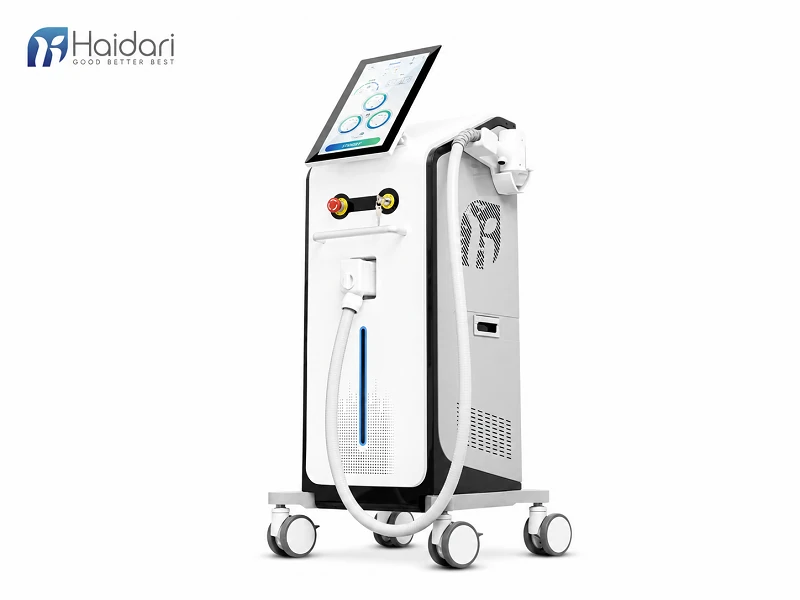
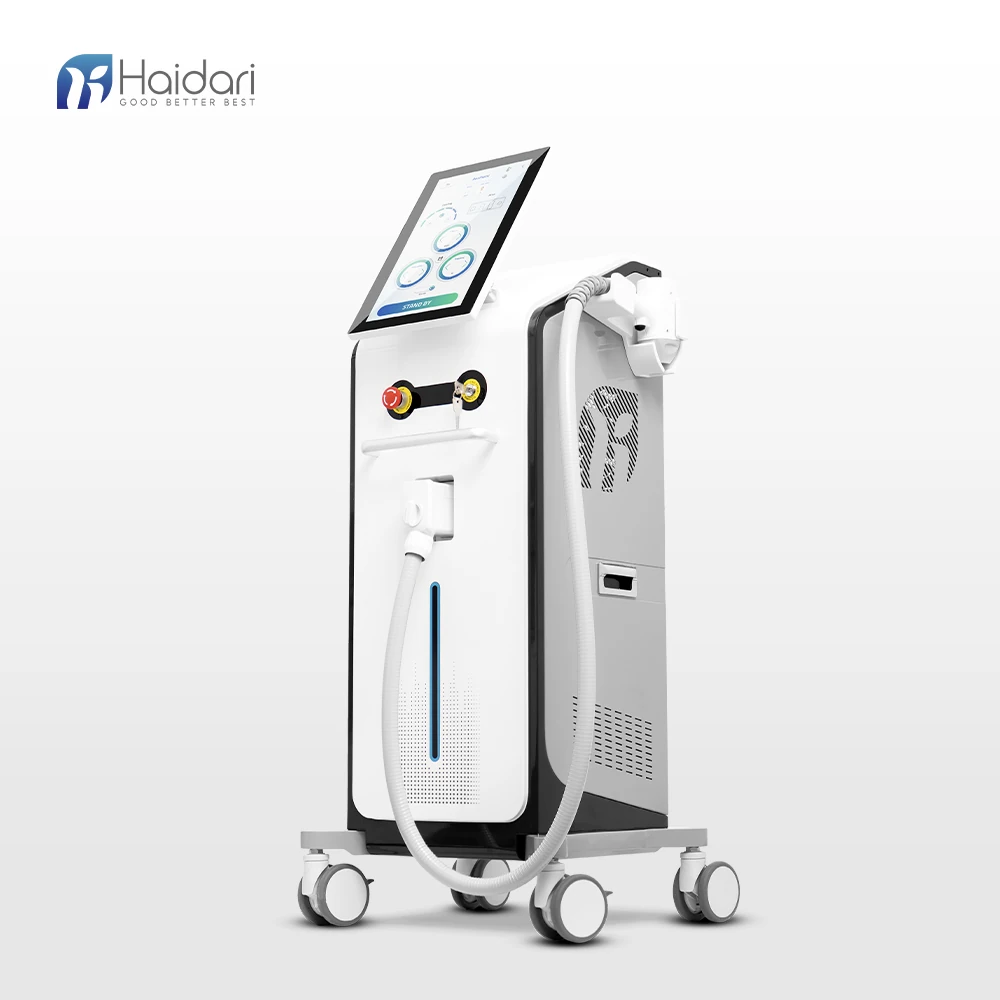
The Stella PRO is the 808nm platform Haidari builds for hair removal, and it answers those three requirements in literal terms.
1800W at the handpiece, and what it changes
The handpiece runs at 1800W from a 4000W machine output, using USA Coherent laser bars at 10 Hz. The fluence set for a dense back therefore stays available at the 12 × 36 mm spot.
Three spot sizes without changing handpieces
Interchangeable tips at 12 × 12, 12 × 24 and 12 × 36 mm cover the range a male list needs: the smallest for beard line, sideburns and ears, the middle for neck and underarm, the largest for back or chest. All three run on one handpiece. Cooling comes from a TEC contact tip fed by an Italy-imported water pump, so tip temperature holds through a long session instead of drifting at the end.
755, 808 and 1064 in one platform
In standard form it is an 808nm diode laser hair removal machine, with 755nm and 1064nm as configuration options. That range is what a mixed male list demands, since a Fitzpatrick II client booked for chest clearance and a Fitzpatrick V client booked for a neckline would otherwise need two platforms.
Rated life runs past 100 million shots, with ODM and OEM support for distributors who need their own branding.
Frequently Asked Questions
How many sessions does a man need?
Most male body areas need six to eight sessions. The beard line and neck often need eight or more, because the hair there is denser and its growth is hormonally driven. Back and chest show clear reduction by the third or fourth.
Is laser hair removal safe on darker skin?
Yes, when wavelength and fluence are chosen for the skin rather than copied from a lighter-skinned protocol. At Fitzpatrick IV to VI, 1064nm is the safer default because the epidermis absorbs far less of it.
Does beard shaping work, or does it only thin the beard?
Both work. Treating below a mapped line gives a defined neckline while leaving the beard intact; reducing fluence and session count across the whole area gives thinner, softer growth. They need different settings, so settle on one at consultation.
Why does the hair look like it is growing back after a session?
Treated hairs are shed rather than vaporised. Over one to three weeks they work out of the follicle and look like they are growing when they are falling out. Warn clients, or they assume failure and cancel.
Can one machine handle both male and female clients?
Usually the same device. Selectable wavelengths and a range of spot sizes let one platform serve both lists, which is why configuration matters more than the headline category. Pulse duration and repetition rate change; the technology does not.
Conclusion
Male hair removal is not a new treatment. It is an existing treatment applied to hair the standard protocol was never calibrated for, on areas larger and more visible than most clinics built their service around. The adjustments stay modest: a longer pulse, a controlled repetition rate, cooling that holds, and a wavelength chosen for the skin in front of you.
The equipment requirement is equally modest but specific: a spot large enough to make a back practical, power that holds dose at that spot, and enough wavelength range to serve your market.
Tell Haidari which areas you treat most and which skin tones you see, and we will build a Stella PRO configuration around that list.