
5 Technical Dimensions to Choose High-Performance Medical Fractional CO2Laser Equipment
Introduction: Deep Correlation Between Clinical Outcomes and Device Parameters
In the global medical aesthetic industry, the final clinical performance of any laser CO2 fractional device is highly determined by its energy output stability and pulse control accuracy. Clinic buyers face a saturated market filled with uneven-quality laser devices, so blind procurement based on low price or appearance will lead to poor treatment effect, frequent breakdowns and profit loss.
2026 Global Laser CO2 fractional Market Data & Authoritative Source
Global aesthetic & cosmetic lasers market valuation: Reached USD 1.07 Billion in 2026, projected to hit USD 2.16 Billion by 2035 at a steady 8.1% CAGR from 2026 to 2035; as a core segmented device, medical fractional CO2 laser dominates ablative skin treatment projects, ranking top on procurement lists of global dermatology and aesthetic clinics.
Regional layout data: In 2025, North America occupied 35% global laser device market share, Europe accounted for 27%, and Asia-Pacific held 28% share. The Asia-Pacific market has huge incremental demand, while less than 12% local devices support a stable 100W high-power laser output, making the Asia-exclusive Haifrax Pro 100W model a scarce premium option for high-end medical institutions.
Latest industry trend: 41% of newly installed aesthetic laser platforms adopt multi-functional integrated design, which proves 3-in-1 mode, including fractional resurfacing, surgical cutting and gynecological rejuvenation, has become a mainstream configuration for profitable clinic laser equipment. (Source: https://www.businessresearchinsights.com/market-reports/aesthetic-and-cosmetic-lasers-market-107395)
Dimension 1: Correlation Between Laser Power and Actual Treatment Depth
Most practitioners believe 40W-60W standard laser power can meet all daily aesthetic and surgical clinical demands.
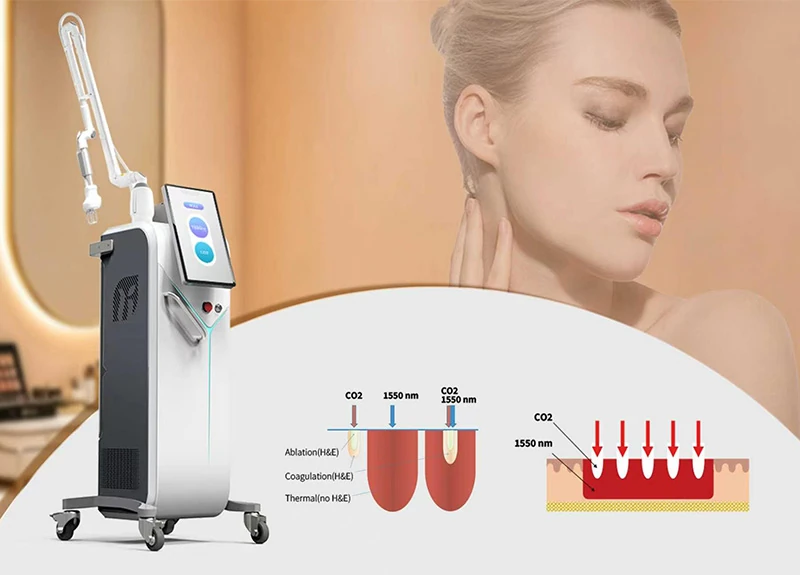
High-power configuration is not designed for stronger laser intensity, but for sufficient power reserve. When repairing deep hyperplastic acne scars or conducting precise surgical cutting, stable high power guarantees consistent laser penetration depth on different skin layers. Notably, the 100W steady-output model represented by Haifrax Pro is a premium exclusive configuration across Asia. This core advantage sets the upper limit of clinical operation for dermatologists when handling complex deep scar repair cases, which low-power laser CO2 fractional devices cannot achieve.
Dimension 2: How Pulse Duration Controls Peripheral Thermal Damage
Buyers only focus on total laser energy while ignoring the magnitude gap of pulse duration, which is the core factor affecting patient recovery speed.
Human skin tissue has an ultra-short thermal relaxation time (TRT). If the pulse duration lasts too long, redundant heat will diffuse to surrounding healthy skin tissue, extending the postoperative redness period and greatly raising the risk of post-inflammatory hyperpigmentation (PIH). Most mainstream ordinary fractional CO2 laser skin resurfacing machine owns 100μs to 1000μs pulse width, while Haifrax Pro breaks the industry threshold with a minimum 10μs pulse width. This ultra-short pulse realizes micro-ablation accurately, maintains ideal treatment efficacy, minimizes thermal damage, and cuts down patient downtime obviously.
Dimension 3: Optical System Stability and Spot Energy Quality
Clinic operators regard the laser optical arm as a simple energy transmission pipeline, ignoring its decisive role in treatment safety.
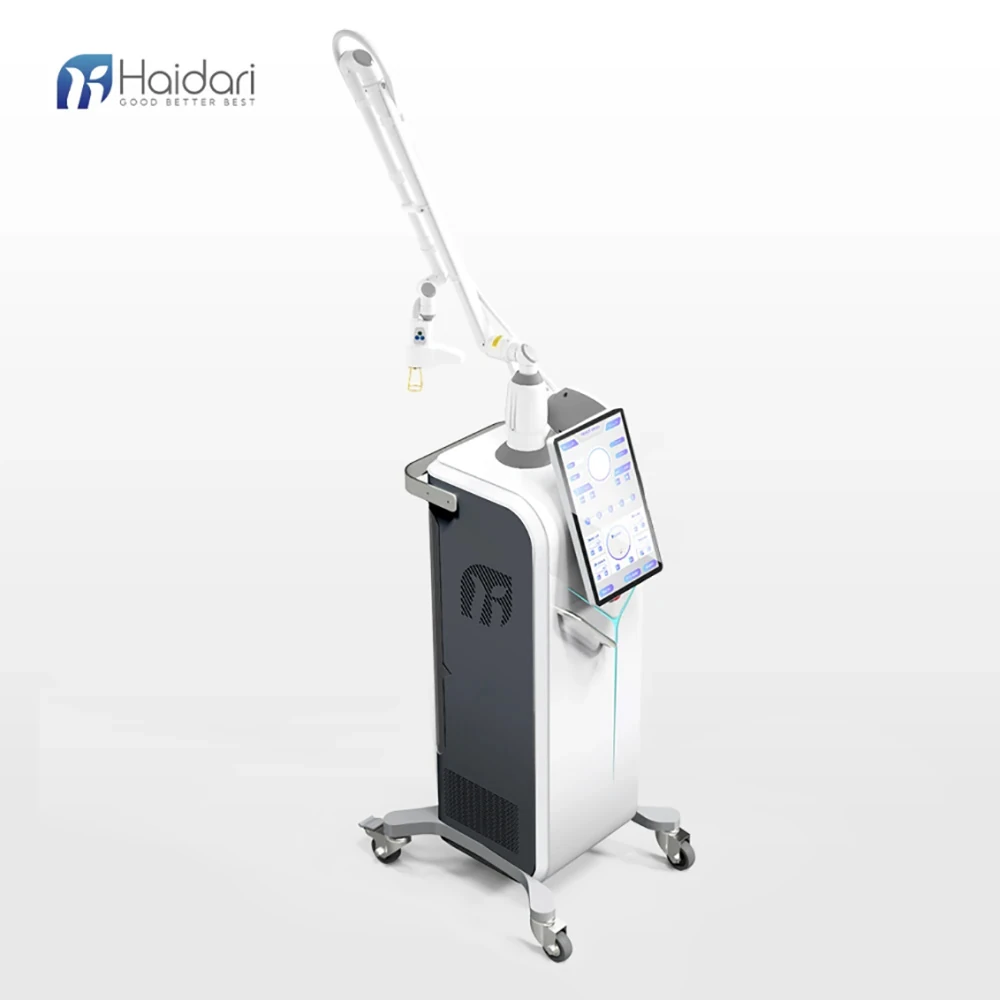
First, the exclusive Z shape cavity optical structure equipped on this medical fractional CO2 laser optimizes internal light path transmission perfectly. Matched with a built-in 6-fan independent heat dissipation system, it keeps a complete symmetrical laser spot shape during 24-hour-long continuous operation. Second, medical-grade devices adopt original U.S. Coherent laser tubes and German imported optical components, delivering flat-top spot energy distribution evenly, preventing local skin burn caused by over-concentrated central energy of inferior laser devices. Third, the built-in patented Galvo scanning motor is the core patented component of this device, ensuring uniform micro-hole energy distribution within the full 20×20mm maximum treatment area.
Dimension 4: Medical Certification and Long-Term Device Durability
Buyers only check basic electronic commodity certificates instead of professional medical device qualification files.
A qualified clinical fractional CO2 laser skin resurfacing machine must pass ISO13485 medical device quality management system certification and IEC60601-1 medical electrical equipment safety certification, two mandatory standards for global aesthetic medical institutions. For busy beauty salons and beauty clinics with high daily patient volumes, device durability effectively prevents business interruptions and client loss caused by unexpected equipment failures.
Dimension 5: Operation Cost and Quantified ROI Evaluation Model
Purchasers merely calculate upfront capital expenditure (CAPEX), neglecting long-term operating expenditure (OPEX), including maintenance and part replacement.
While most laser equipment brands only offer a one-year warranty on the entire machine, Haifrax Pro offers an official five-year warranty on the core laser tube and optical system, significantly reducing long-term maintenance costs. With its comprehensive therapeutic capabilities and high returns typically exceeding $500 per treatment, the device can usually recoup its initial investment within two months of purchase; over its entire lifespan, the return on investment (ROI) can even exceed 100:1.
Quick Comparison Chart
| Selection Dimension | Ordinary Low-Grade Laser Device | Haifrax Pro Professional Standard | Core Procurement Reason |
| Pulse Width Parameter | 100μs – 1,000μs long pulse | 10μs ultra-short pulse | Reduce peripheral thermal injury, prevent postoperative skin darkening |
| Stable Output Power | 40W – 60W low power | 100W Asia-exclusive stable high power | Strong tissue penetration, faster acne scar and stretch mark removal effect |
| Core Optical Parts | Generic unbranded laser tube | Original U.S. Coherent laser tube | Guarantee beam stability and over 5-year service lifespan |
| Built-in Heat Dissipation | 1-2 cooling fans, easy overheating | 6 cooling fans + 24h continuous operation design | Adapt to high daily patient volume, zero downtime during peak business hours |
FAQs
Q1: Do you have training?
A: Yes. Official one-on-one video operation and clinical treatment training will be provided after clients receive the laser CO2 fractional machine, matching customized treatment parameters for different skin conditions.
Q2: Can this work stably under high temperature and high-humidity clinic environment?
A: Yes. The equipment adopts an industrial-grade design, supports 24-hour continuous operation, and can adapt to the extreme temperature and humidity operating environment of various medical aesthetic clinics around the world.
Q4: Is the patented scanning motor replaceable for daily maintenance?
A: The patented internal Galvo scanner is assembled with an integrated anti-loose structure; the professional after-sales team provides remote maintenance guidance globally to avoid improper manual disassembly damage.
Final Conclusion
For beauty salons, aesthetic clinics and professional dermatology clinics pursuing safe, efficient and profitable long-term business, investing in a certified, high-power medical fractional CO2 laser is a strategic decision rather than an optional equipment purchase. Unlike conventional low-power fractional CO2 laser devices with limited parameter performance, the Haifrax Pro 100W model features authoritative medical certification, patented scanning motor technology, 10-microsecond (μs) ultrashort pulse technology, a three-in-one multi-scenario treatment mode, and a market-proven high return on investment (ROI) profit model. As a mature medical-grade fractional CO2 laser skin rejuvenation device, it perfectly balances clinical safety, diverse treatment capabilities, and clinic profitability, and will become the preferred laser device for global medical aesthetic institutions in 2026 and beyond.